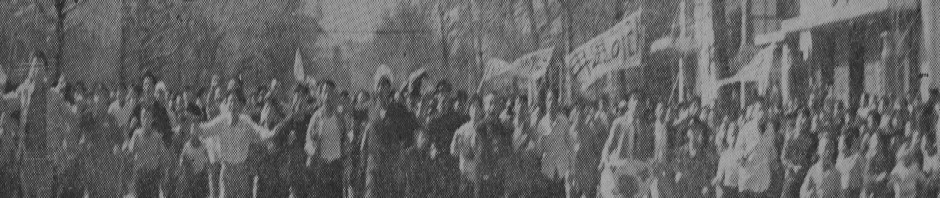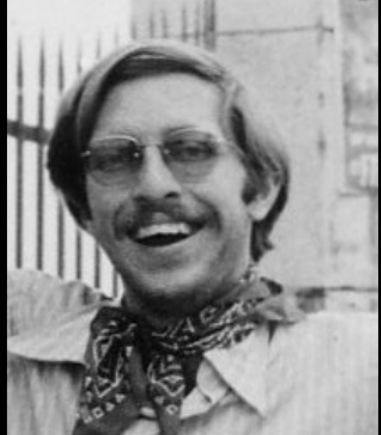
Kim Dae Jung speaks (1985)

November 11th, 2009

In a long-lost interview, the former dissident and president of South Korea speaks about Kwangju and the U.S. role in his country

The Kwangju people kept order; paratroopers broke order…You should have criticized the paratroopers’ side, not the Kwangju people’s side. Your attitude was not just, not fair.

I recently found in my files an interview I did in 1985 with Kim Dae Jung, the late president of South Korea and the leader of its democratic movement. Here’s my thoughts about Kim and a transcription of the article, which appeared in The Progressive magazine in February 1986. A PDF of the original article is attached below.

19kimspan600.jpg

By Tim Shorrock

On August 18, 2009, Kim Dae Jung, the former president of South Korea and that nation’s leading dissident during its long period of military dictatorship, died in Seoul of heart failure.

News of Kim’s death came as a shock to millions of Koreans, north and south. For decades, Kim had stood almost alone as a symbol of the deep Korean desire for democracy and independence, and was revered on both sides of the border for his commitment to unification and reconciliation between the two Koreas.

As a journalist who has written extensively about Korea for the past 30 years, I too was deeply saddened by Kim’s passing. My feelings were shaped in part by my personal experience with Kim, whom I had met several times during his years of exile in Washington in the early 1980s.

During that time, I worked closely with a faith-based coalition that sought to focus public and congressional attention on South Korea and the deep ties between its authoritarian leaders and the U.S. military. Kim spoke to the coalition several times, giving his impressions of US-Korean ties and how they could be improved.

KIM’S OPTIMISM

Two things struck me about Kim during our meetings. One was his deep Christian faith and his boundless optimism about the possibility of change. Even in the darkest days of the military dictatorship, he expressed a strong belief that democracy would be restored to South Korea. Many supporters found that concept hard to embrace, given the enormous US military presence there and the huge US economic stake in South Korean industry and trade.

The other was his love for America and his profound faith that the American people and their leaders would eventually do the right thing in Korea. Sometimes I thought he was incredibly naïve: throughout the Cold War, the US government had supported savagely repressive governments, such as Chile’s after 1973 and Indonesia’s after 1965, in the name of national security, and did it for decades in South Korea. At the same time, Kim for years was the subject of a vicious campaign of slander by US officials who portrayed him as a dangerous and unbalanced leftist. To me, it seemed incredibly unrealistic to think that would ever change. But it did, and Kim turned out to be right on many fronts.

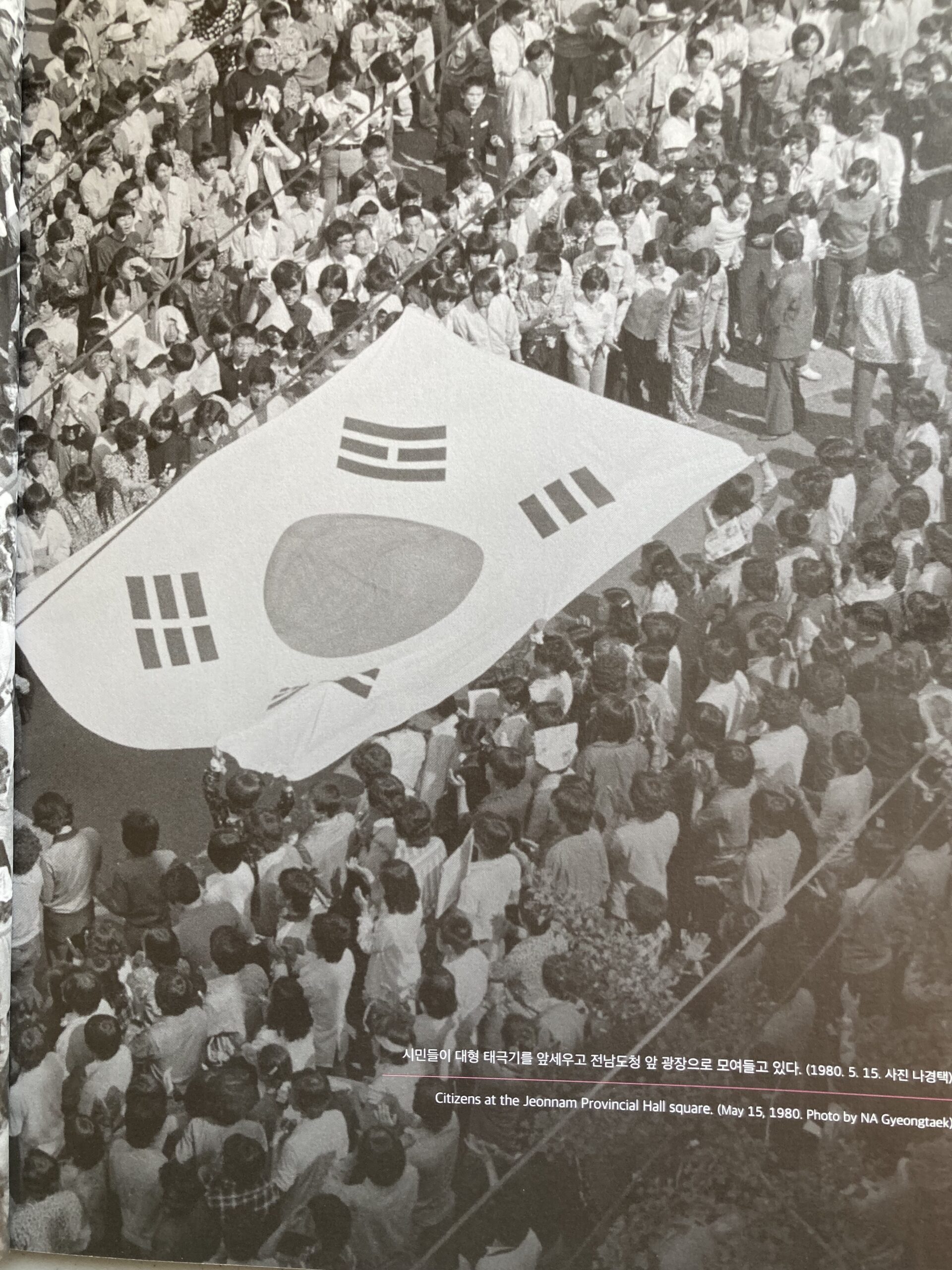
My fondest memory of Kim Dae Jung is from 1985, when I met him at his home, shared a traditional (and delicious) Korean meal, and sat down for an extensive interview. I had just spent several weeks in South Korea meeting with student and labor activists, and was there to write about the growing movement against the US-supported dictatorship of Lt. Gen. Chun Doo Hwan, who had seized power in a violent coup in May 1980. During my visit, I had spent several days in Kwangju, Kim’s home town and the site of the infamous Kwangju Massacre, when hundreds of students and workers were gunned down and bayoneted to death for standing up to Chun’s coup (details from my reporting can be found in the PDF of my Progressive article, “Korea: Stirrings of Resistance.”)

All of this was very personal for Kim, who was arrested in the wake of the massacre, charged with organizing the uprising, and sentenced to death. In December 1980, Chun spared Kim’s life as part of deal in which his illegitimate government was recognized by the incoming Reagan administration (Chun was Reagan’s first official state visitor to the White House). Kim was released in 1981, and spent the next four years in the United States before returning to Seoul in 1985.

My interview with him was thus critical to my work. When I met him in June 1985, his home was surrounded by military police and his freedom of movement greatly restricted. In the days leading up to the interview, I had witnessed several clashes between student activists and riot police, and my clothes still reeked of the vicious pepper fog used by the cops to disperse crowds.

MY LUNCHEON WITH KIM

The day I met with Kim, he was in a great mood despite the security cordon around his house in central Seoul. To my surprise, he remembered me. During one of his talks in Washington, I had asked him about his views on nuclear power and the US campaign at the time to pressure the Korean government to buy power plants from the US companies Westinghouse and Bechtel. He hadn’t said much in reply – and Kim told me, with a laugh, that I had probably been disappointed in his answer.

I had been; but I was definitely not disappointed with what Kim told me in our interview that day. For the first (and only) time, Kim addressed the sensitive issue of Kwangju and the manner in which the Carter administration, led by Richard Holbrooke, then the Assistant Secretary of State for Asian and Pacific Affairs, had responded to the tragedy.

Essentially, Carter and Holbrooke – enthusiastically backed by Carter’s national security adviser Zbigniew Brzezinski - saw the Kwangju incident as a threat to the US-South Korean military relationship and therefore something that threatened vital American interests. At the height of the crisis, as I’ve described in articles based on declassified documents from the time, the Carter administration decided not to break with the Chun regime and instead tried – and failed - to coax a group of military gangsters into democratic reform. Military and economic aid continued, and the people of Kwangju were dismissed as “radicals” and “extremists” who had brought the calamity on themselves. It was a disgraceful performance, and persuaded many Koreans that America could never be trusted again.

Kim Dae Jung knew first-hand what had happened to his compatriots, and in our interview that day expressed deep anger about what had occurred in Kwangju. He publicly criticized the US government for its unequivocal support for the Chun military group and equated that backing to “supporting” the massacre. By releasing a division from the combined US-South Korean command to put down the uprising in Kwangju, he argued, the Carter administration allowed Chun to take power.

“If America had not sent one division to Kwangju, Chun Doo Hwan would not have succeeded in getting power,” he said. “If the Americans didn’t support that paratroopers’ massacre, then our people would have risen up for democracy in other cities. We could have succeeded in restoring democracy.”

In our interview, Kim also laid out his vision for a future, democratic South Korea and expressed his deep hopes for reconciliation with the North. “In the future, we can realize strong security because we can enjoy the people’s voluntary support and also force North Korea to have a sincere dialogue to bring peace to the Korean peninsula,” he told me.

PEACE TREATY FIRST, THEN US TROOPS CAN EXIT

Kim was very direct about the role of American forces in his country. They needed to be in South Korea then, he said, because “there is no strong security under dictatorial rule.” But once there was peace, he insisted, the need for US forces would disappear. “We would raise conditions for a permanent peace treaty to ask America troops to withdraw from South Korea.”

Much of Kim’s vision became reality, and he died knowing that the people of Kwangju had been vindicated and the threat of war between North and South Korea greatly diminished. But nearly 30,000 US troops remain in South Korea and a US commander remains in control of Korean forces in times of war – making South Korea the only country in the world where a foreign army exerts such influence. As the recent clash between the North and South Korean navies illustrates, we’re still a long way from peace and reconciliation in Korea.

Still, Kim’s vision remains. I’m proud to have known this great fighter for democracy, and will always treasure the Chinese calligraphy he wrote for me that long ago day:

To care for the People
As if They were Heaven.

stirrings-of-resistance-the-progressive.pdf

_____________________

AN INTERVIEW WITH KIM DAE JUNG
As published in The Progressive, February 1986

Kim Dae Jung, South Korea’s best-known dissident, was imprisoned and sentenced to death for treason in 1980 on trumped-up charges of instigating the Kwangju Uprising. Freed in 1981 after strong pressures from around the world, he moved to the United States, where he spent four years writing and lecturing. Last year, with former political rival Kim Young Sam, he organized the Council to Promote Democracy and returned to South Korea to rejoin the democratic movement.

Though hated by the Korean military, Kim is basically a conservative. Many dissidents mistrust him, fearing that he may put his political ambitions above the broader needs of the opposition. They also criticize what they consider to be his pro-American attitude. But his courageous struggle against military rule has also earned him widespread admiration and respect.

I interviewed Kim last June, a month before he was placed under house arrest again. Here are some excerpts from our conversation:

Q: Was the United States responsible for the Kwangju Uprising and its bloody suppression?

A: You dispatched a Korean division to Kwangju to keep order, but before sending troops, you should have examined which side was keeping order – the Kwangju people or the paratroopers. The Kwangju people kept order; paratroopers broke order. They massacred peaceful demonstrators. They massacred many young men after binding them. Their hands were bound by their sides, but they were killed. They were unable to fight. So you should have criticized the paratroopers’ side, not the Kwangju people’s side. Your attitude was not just, not fair.

If America had not sent one division to Kwangju, Chun Doo Hwan would not have succeeded in getting power. If the Americans didn’t support that paratroopers’ massacre, then our people would have risen up for democracy in other cities. We could have succeeded in restoring democracy. Chun was not so strong then; he was not supported by our people. Only America supported him.

Q: Do you favor the withdrawal of the 40,000 US troops stationed in South Korea?

A: In the future, we can realize strong security because we can enjoy the people’s voluntary support also force North Korea to have a sincere dialogue to bring peace to the Korean peninsula. We would raise conditions for a permanent peace treaty to ask American troops to withdraw from South Korea. But at the present, it is too early for us to ask for the withdrawal of American troops from South Korea because there is no strong security under dictatorial rule. The dictatorial government fails to get the people’s voluntary and full support.

Q: What kind of economic system would you like to see in South Korea?

A: Well, we are supporting the free-market system. We never want to damage our ability to promote exports. So we don’t support any laborer’s request to ask a higher wage compared to promotion of productivity. On the other hand, our country has for more than ten years promoted exports on the international market with a low wage. But the low-wage era has passed. There is the Chinese competition – they are competing with Korea at a far lower wage. So we must escape the need for such an era.

Now we are seeking high-technology production. To succeed in such a high-tech era, we must liberate two groups; one is businessmen. In this country, all businessmen are under government control. Even though they have become rich men, there is no freedom of businessmen. We must liberate them so we can have free competition and fair competition. And also we must liberate our laborers from suppression. Only when laborers are active and willing to produce very good quality goods can we succeed in high-technology.

Q: How unified is the opposition movement?

A: The democratic movement is well unified. Kim Young Sam and I are maintaining close cooperation – no split. And we are seeking a very healthy common goal: Western-style democracy, a free-market system, and supporting the rights of consumers and laborers. We are seeking a very prudent social-welfare system. And we support the national security. We criticize America and Japan, but we don’t want to become anti-American and anti-Japanese.

Q: How hopeful are you that democracy will return to South Korea?

A: I am carefully hopeful. But whether we can reach our democracy easily and peacefully may depend on whether we can avoid military involvement in politics or not – and that depends mainly on the American commander’s attitude. As long as the American military commander has the right to control all Korean military forces of 600,000 troops, the American commander must take the responsibility to prevent military involvement in a coup.

You know, when there was the Korean War thirty years ago, there was democracy – in wartime. We had freedom of speech, local autonomy, direct election of the president, the independence of the national assembly and the judicial branch. But at peacetime now, we have lost all of those freedoms. In wartime, our people’s per-capita income was only $16; now it has soared to $2,000. But we can’t enjoy the same freedom we had when it was $16. How can we understand that?

Remembering Hurricane Katrina

August 30th, 2009

common-grounds-76_1.jpg

Covering Hurricane Katrina was one of the hardest assignments in my 30 years in journalism. I wrote this story after spending two grueling days walking through the Lower Ninth Ward, accompanying families who were coming back there for the first time since the calamity. I will never forget the strength and dignity of the people I met during those days, and often wonder what became of them. My story was published by the Institute for Southern Studies‘ Gulf Coast Reconstruction Watch. The photos were shot by my friend and colleague, Kike Arnal.  

VOICES FROM THE NINTH WARD

By Tim Shorrock

NEW ORLEANS – Michelle McKenney Jones stood last Friday, December 2, outside of the home in New Orleans’s Lower Ninth Ward built by her grandfather in 1953 and where her mother lived until Hurricane Katrina and Rita swept through the area. It was only the second day that local residents were allowed into her neighborhood, which was demolished by flood waters spilling from the nearby levee that was breached during Katrina.

Jones, who now lives in Nashville, sighed as she surveyed the house, which was knocked off its foundations and is now uninhabitable. The social impact of the disaster in the Ninth Ward, she said, was compounded because this neighborhood once had the highest percentage of black homeownership in the entire Parish of Orleans. Then she paused as her emotions caught up with her.

“You’ve got to be our voice,” she told me and Kike Arnal, the photographer who was accompanying me. “This community doesn’t have a voice. Nobody seems to be listening to us. Represent us, please.” As she spoke, tears filled her eyes and rolled down her cheeks. Kike and I stood with her in silence for a minute, trying to share her grief, and assured her that we would hold her words in our hearts.

That conversation was one of the most poignant I experienced in two recent visits I made to New Orleans, where I’ve been working on assignment for Mother Jones magazine. Jones’s plea underscored the tremendous responsibility I feel as a journalist to share what I’ve learned here with the American public, which is fast losing interest in New Orleans as the media shifts its focus to other concerns and government agencies continue to demonize the African-Americans who make up the majority of this wounded but wonderful city.

common-grounds-137_1.jpg

I spent 10 days in New Orleans in late October and early December, 2005 During my first visit, the streets of the Lower Ninth Ward were closed to the public. But it was possible to get a sense of the damage by visiting the Disaster Recovery Center at the intersection of North Claiborne and Caffin Avenues, where the Salvation Army and other private groups had set up tents and vans to provide food, water and other supplies to residents and the rescue workers still pulling bodies from houses in the neighborhood. Common Ground, the collective that runs a free clinic in New Orleans’s West Bank and a distribution center in the Ninth Ward, was also using the site for biweekly mobile clinics.

Throughout the area, in every direction, all I could see was complete devastation. Every structure in the Lower Ninth had been severely damaged, many of them obliterated. Cars and vans lay overturned and smashed, and some vehicles were pushed by the water into homes and storefronts, where they were buried amidst tons of debris. A dry, grey film of toxic mud covered every street and sidewalk, and spread into homes and storefronts; near the disaster center, the thickest mud was cordoned off with yellow tape reading “Caution: Chemical Spill.” Here and there a boat could be seen leaning incongruously where it was abandoned after the water receded. Refrigerators closed with large straps and filled with rotting food stood at busy street corners like silent sentries. Stray dogs ran through the area, apparently the only survivors of the flood. Piled on every street was garbage and waste. And posted on nearly every telephone pole was a sign from a local entrepreneur trying to make a killing off the suffering: “I Buy Homes, Any Location or Condition/Cash in Three Days.”

One of those taking advantage of Common Ground’s free medical services at the recovery center was Audrey Whittington, 54. She came over to the clinic’s tent after watching her two teenage sons receive tetanus shots from Jim, a Common Ground volunteer nurse from New Mexico. Although she said she hates needles, Whittington decided to get an injection anyway, and afterwards spoke to me about her experiences during and after Katrina.

Whittington left the Ninth Ward a few days before Katrina hit because she was sick, and went to Mississippi to be with her family and ride out the storm. “Once I got there, I was feelin’ good – so maybe that sickness was a sign, a blessing.” But after the levee broke, she watched in horror as her neighborhood was engulfed in water and people scrambled to be rescued. Later she learned that her best friend had died in the flood, inside her own home. But the body wasn’t found for weeks; after Rita came through, the family asked the National Guard to look for her. But the Guardsmen reported back they’d found nothing and wrote a large zero on the house indicating no bodies had been found. Then, nearly a month later, the woman’s sister went over to the house and found her.

“The government doesn’t tell you everything,” said Whittington, expressing the deep mistrust of the feds that is so common in this city. Her house, she said, “is completely gone.” Worse, because she’d put the house where she’d lived for 16 years up for sale just before the storm, she’d let the flood insurance lapse. Now all she has is a simple homeowner’s policy, and that is likely to cover just a fraction of her loss. Plus “FEMA only gives you so much.” But even if she comes up with enough money to rebuild, “there’s no way I can go to my house when the rest of the houses around are gone. You think I’m going to live in a neighborhood that’s just me? With a levee that could break? I just don’t know what to do.”

Earlier, Whittington had taken advantage of a tour bus that, courtesy of the city government, had been shuttling people around the Ninth Ward to allow them to see their neighborhoods. “Get on that bus, and what you’re gonna see gonna make you think you been in Vietnam,” she said. “There’s houses on top of houses, there’s cars on top of cars. It’s breathless to see something like that.” She turned to leave. “All we can do is hope and pray, keep your sanity and just ask God to give you strength to get you to the next step because this one’s gone” – meaning her neighborhood – she said. “But at least I’m alive.”

As we spoke, I noticed an Asian man sitting pensively on a chair behind us, taking in the scene. He identified himself as Win Saan, a former soldier with the South Vietnamese Army. He came to the United States in 1978, three years after the end of the war, and eventually settled in Kenner, a suburb of New Orleans. Until Katrina, he had a small medical practice with an office just around the corner from the Disaster Recovery Center. “We don’t have our clients anymore,” he said sadly. All his people are gone and living in places like Baton Rouge, New Iberia and Houston. I asked Win if he thought his patients might return to the Ninth Ward. “I don’t think so,” he replied. “If the levees are weak like that, they get scared.”

The next day, I ran into Clyde Bloodwirth, 69, picking up cleaning supplies at the Common Ground distribution center at the corner of Louise and North Robertson Streets. His house was just around the corner, in an area that was heavily damaged although not quite as badly as those in the Lower Ninth. Still, Bloodwirth’s story was a harrowing one. He and his wife didn’t evacuate the city and, when the water came, were trapped in their house with their daughter and three grandchildren.

After nearly 48 hours on their roof, they were taken by boat to a spot on Interstate 10, where they remained for five long days. “They had nothing for us up there,” Bloodwirth said of the disorganized and belated rescue efforts by the federal government. Then, like so many others, Bloodwirth and his family were flown by US transport planes to destinations they only learned about after they landed – first Atlanta, then Mobile and finally Houston. Bloodwirth was now living with his sister in Metarie, just outside of New Orleans, and returning to the city every day to begin repairing his house. He thinks he can make it livable again, but only after clearing out all the debris and gutting everything but the frame.

A month after this interview, I was in the Lower Ninth again, working with Kike on our feature for Mother Jones. On December 2, we drove to the Disaster Recovery Center, which by now had been taken over by FEMA, the Environmental Protection Agency and the Small Business Administration.

As before, the area was heavily protected by National Guard troops and New Orleans police, but this time there was the added presence of two armed officers from the Immigration Customs Enforcement division of the Department of Homeland Security. There were also four security personnel from Blackwater Inc., the North Carolina private security company that has made a fortune providing security to US officials and contractors in Iraq. Blackwater first showed up in New Orleans right after Katrina to protect the palatial homes of the wealthy.

Last week, however, Blackwater was guarding FEMA. Four young guards, wearing black shirts with Blackwater insignia, matching green chinos and the same wrap-around eyeshades, stood stiffly around the FEMA tables. FEMA couldn’t have tried harder to underscore its utter estrangement from the people of New Orleans and the private and public agencies providing relief to the city.

As Kike and I drove up, we spotted a family getting out of a van and pulling on white overclothes to protect themselves as they entered their homes for the first time since the storm. We asked them if we could accompany them, and they readily agreed. It was a family of four: Evelyn Gilbert, and her three sons, all in their 50s: Rhett, Gustaf and Daniel. I felt privileged to be with them on such a sacred moment. Kike and I followed them slowly down North Claiborne (where I had walked a month before only to be stopped by the National Guard) and into a little cul-de-sac near the canal. We stopped and got out in front of a long white house completely off its foundation. Next to it was a tiny blue structure, leaning crazily to one side with its roof caving in. It had been Evelyn’s home, and was built in 1978, she said; the rest of the family lived next door. The heavy line at the top of the roofs showed that both houses had been almost completely under water.

common-grounds-100_1.jpg

As the Gilbert brothers explored their property, I hung back, feeling like an interloper and trying to avoid being intrusive. After a while, I asked Evelyn, who didn’t want to go near her house, where she was when the water came. She told me she was evacuated on the Friday before the storm, and ended up in Houston; she’s now staying in Mississippi with family. She watched anxiously as her sons pushed open her front door and gingerly took a few steps inside the destroyed house. Finally, Rhett walked out carrying a portable barbeque. “We found something at least,” he said. “But it’s the only thing salvageable.” He dusted it off as best he could and loaded it into the van.

Gustaf and Daniel then went to look at their house as Rhett told me a little about the neighborhood. “I was born and raised here, and this is the only place I know,” he said. “I know this city like the back of my hand.” He motioned to the other broken structures near their property. “All these are kin-folk. Used to walk to the church over there, the store.” Now, he said, he lives in Dallas, and everywhere he walks he runs into another freeway; worse, the services he needs are far away. He had no idea if he and his family will return, or where his former neighbors are. Finished with their short tour, the Gilbert family shook hands with Kike and me and slowly drove away.

It was about half an hour later that we ran into Michelle Jones as she took in her mother’s house with a local carpenter. The house, which her grandfather had clearly taken great pride in, was first destroyed when the levee was blown up during Hurricane Betsy in 1965; after he rebuilt it, it lasted until Katrina, when it was destroyed again, this time for good. Mayor Ray Negin, who’s now telling the people of New Orleans to come back, should visit this area of the Ninth Ward, she told us; he might not be so optimistic if could see the catastrophe for himself.

“Represent us, please,” she said once again. As she turned to leave, her mother called out: “And pray for us.” We watched them drive off, the gray dust picking up behind them.

common-grounds-19_1.jpg


common-grounds-105_1.jpg

Echoes of Cold War past in torture report

August 26th, 2009

My latest published piece, from the London Guardian (go there for all the links).

Hidden deep in the CIA Inspector General report on the Bush/Cheney torture regime are references to interrogations and torture in Vietnam and Central America. Plus: How Tenet, Gonzalez and other architects of a shameful chapter in the CIA’s history now reap rich rewards in the private sector.

BY TIM SHORROCK

WASHINGTON - Monday’s release of the long-awaited CIA report on the agency’s role in torture and interrogation brought me back to 1967, when I was a high school student opposed to the Vietnam war. Angry that my history teacher was only presenting the official story, I persuaded her to allow my class to read Vietnam! Vietnam!, a powerful indictment of the war by the British reporter Felix Greene. It was filled with disturbing images, including a haunting photograph of a Vietnamese fighter being waterboarded while American soldiers looked on. But my teacher and fellow students dismissed the book as propaganda, preferring instead the sanitised version of the war provided by the US government.

The CIA report, however, is the official word on the Bush-Cheney “war on terror”. In gruesome detail, it shows how untrained CIA interrogators and private contractors, blessed by their superiors, inflicted detainees captured in the Middle East with “enhanced interrogation techniques” that ran the gamut from mock executions to threats to kill family members to waterboarding. While the intelligence provided important details about al-Qaida and some information about possible attacks, the report concluded that the interrogations violated US commitments to human rights and showed that the CIA “failed to provide adequate staffing, guidance and support” to those involved.

CIA director Leon Panetta attempted to downplay those findings by saying that “the challenge is not the battles of yesterday, but those of today and tomorrow”. But we know from the American experience that is not true: as in Vietnam, we must come to grips with the fact that using the ends to justify the means has destroyed thousands of lives and stirred deep hatred for the US.

Curiously, there is a reference to the American cold war past in the CIA report. After Vietnam, it said, US interest in interrogation faded, only to re-emerge with US intervention in Central America as a way to “foster foreign liaison relationships” – presumably with the anti-communist governments such as El Salvador and Guatemala. But in the mid-1980s, after two CIA officers were investigated for killing a detainee – in a country blacked out in the report – the agency said it ended its so-called “human resource exploitation” programme.

Attorney general Eric Holder has now appointed a prosecutor to examine the dozen or so cases where the CIA believes US laws were broken after 9/11. But the prosecutor’s mandate is narrowly defined, and will not cover those who acted “in good faith and within the scope of legal guidance” provided by the White House through the justice department. If so, that is a travesty: the plan eliminates those most responsible, including the justice department lawyers who wrote the CIA guidance under the tutelage of the president, George Bush, the vice-president, Dick Cheney, and the CIA director, George Tenet.

Adding insult to injury, some of those responsible have been rewarded with lucrative careers in the private sector. Tenet, for example, is making millions of dollars in the intelligence business, including as a board member for defence contractor QinetiQ. And Jose Rodriguez, the former director of the CIA’s National Clandestine Service who ordered the destruction of CIA interrogation videotapes, works with former CIA director Mike Hayden at the oddly named National Interest Security Company, an intelligence contractor. It’s shameful that people responsible for one of America’s darkest chapters are so richly rewarded.

Back in 1967, Greene dedicated his Vietnam book to American opponents of the war who had “affirmed for all the world to see what is best and most humane in the American tradition”. We can restore that tradition by seeking justice for the officials who violated America’s trust in its constitution and basic human rights. It’s the least we can do for our democracy.

An American in Hiroshima

August 6th, 2009

hiroshima.jpg

Steve Leeper is an American in an usual position: he is the first foreigner to run the Hiroshima Peace Culture Foundation, the organization that operates the museums and memorials in the first city attacked by nuclear weapons.

Steve’s been getting a lot of attention in Japan, including this 2007 interview with the Japan Times. It’s a fascinating read, and well worth the time as we contemplate the 64th anniversary of the bombings of Hiroshima and Nagasaki.

A personal note: Steve is one my family’s oldest friends. We’ve known each other since the early 1950s, when our parents’ were working in postwar Japan as missionaries. An excerpt from his interview:

When it comes to the question of whether the United States was justified in dropping the “Little Boy” atomic bomb on Hiroshima and “Fat Man” on Nagasaki three days later together instantaneously claiming 210,000 lives Leeper agrees with Japanese at both ends of the political spectrum that those attacks were inexcusable.

Nuclear bombs are inhumane, inflicting vast destruction and indiscriminate slaughter in the span of an instant. Their use cannot be justified, regardless of the reasoning applied,” he is on record as declaring (in fluent Japanese)…

“Wherever I go, I am constantly encountering people of all stripes who really understand that we just cannot continue to have wars and we certainly can’t start throwing nuclear weapons around if we intend to solve these other problems that we’re facing. And yet our leaders, the leaders of most countries right now, are people who grew up through the war culture.

“Many of them derive directly from the military-industrial complex, many of them are weapons dealers or weapons manufacturers or get their money from manufacturers and dealers, so there’s this highly competitive, highly aggressive bunch of warriors who are leading the world when most of the people want peace.”

For a photo documentary of the Nagasaki bombing, which occured on August 9, 1945, click here. (This is a repost from 2007)

SPIES FOR HIRE reviewed in New Zealand

July 25th, 2009

My book, SPIES FOR HIRE: The Secret World of Intelligence Outsourcing, was just reviewed in Converge, the publication of the Anti-Bases Campaign, the largest peace group in New Zealand. That country is home to several important U.S. intelligence installations that have been the target of dozens of protests over the years. Jeremy Agar, the reviewer, really “gets it” about my book, particularly my analysis of the ideology of intelligence privatization - something that has been missed and overlooked by most reviewers in the United States. I appreciate his insight and the work done by ABC to bring peace to our world.

 image003.jpg

By Jeremy Agar

“SPIES FOR HIRE”
by Tim Shorrock, Simon & Schuster, New York, 2008

It used to be so simple. In the crude formulations of Joseph McCarthy, spies betrayed America by hiding rolls of film in pumpkins and phone booths for Russians to deliver to Stalin, while the Federal Bureau of Investigation (FBI and its founding Director J Edgar Hoover shadowed them. Now it’s a different game. Spying is being privatised and contracted out, and so treason has been redefined as opposition to corporate America.

After an earthquake or a flood the looters come out. For corporate looters 9/11 was a perfect storm, the chance for the perfect heist. Motive: get what you can while you can. Opportunity: a moment when the world tolerated American power; and advances in computer technology. Alibi: Mix legitimate and opportunistic motives and hide behind a lexicon of soothing platitudes to do with partnership, security, innovation and intelligence; when in doubt, bang on about “terrorists”.  America spends around $US60 billion a year on intelligence gathering, $US45 billion of which is going to private contractors. “Spies For Hire” tells the story. It’s a fascinating account, detailed and scholarly. Although it’s comparatively long, it never goes off topic, which is the privatisation of spying and how it came about. Shorrock, a journalist, knows his subject well.

It started with the ideological bias of the 1980s’ Reagan presidency, when the President told his people that the Government he had been elected to guide was the “problem” - a languishing economy and society - that America had to solve. President Bill Clinton was more centrist, but his terms coincided with the end of the Cold War, when it became harder to justify a huge military budget and, caught short by Iraq and Afghanistan, the Government had to contract out. This misleadingly plausible explanation for the privatisation of spying has commonly been noted, but Shorrock, while he doesn’t necessarily disagree, has much more to say.

GIG, Netcentricity, C3I, TIA

Something called The Global Information Grid (GIG) was the brainchild of Donald Rumsfeld (President George Bush’s first Secretary of Defense. Ed.), “the man who forced the armed services to embrace the revolutionary, information technology-driven concept of network centric warfare. The road to military domination, he believed, was to create a global, network-based communications system for all information and intelligence on military operations; transformation and ‘netcentricity’ were the keys to future American power”.

Eccentricity we understand, but just what is “netcentricity”? Shorrock quotes one official sounding definition, which explains that it’s to do with “communications infrastructure that supports intelligence missions, and enhances information sharing … from military bases in the United States to tactical mobile platforms”. Still confused? Shorrock couldn’t make sense of it either so he asked an intelligence expert. He too was “having a little difficulty figuring out whether the GIG is a piece of hardware, a programme or a slogan”. The expert thought GIG was an aspect of C3I. And C3I is command, control, communications, and intelligence. So that’s cleared that up. The vagueness helps the power elites, who are themselves all about C3I. Money for the military and the spies has always sloshed about in budgets hidden from public view and the new dispensation allows for even less accountability. For potential watchdogs GIG creates a shifting and often invisible target.

It might sound as new as tomorrow, but the hope of total knowledge in order to exercise total power has been around a long time, and not just in science fiction. Way back in President Eisenhower’s day, in the 1950s, the US military worked on a Single Integrated Operational Plan. More recently Reaganites hatched a Total Information Awareness scheme [TIA], a misnomer in that Congress was kept in the dark. After Congress found out about it, TIA was scrapped. The politicians aren’t too happy about “netcentricity” either, perhaps seeing that once outsourcing is added to secrecy, their shelf life might be short (for another discussion of TIA see my review of “Spies, Lies And The War On Terror”, in Peace Researcher 38, July, 2009).

Intelligence Industrial Complex

Shorrock has come up with his own acronym. He calls this new world order the “Intelligence Industrial Complex”. He’s alluding to Eisenhower’s warning of an emerging “military industrial complex”. Fifty years ago, as he left office, the popular Ike, who had been commander of the Allied Forces in World War 2, was emboldened to point out what he felt unable to express as President: that the combined interests of the military and the corporations who served them were effectively running the country. Progressive, democratic opinion had long been making this point, but Eisenhower’s conservative credentials and his mana within Washington circles gave the phrase authority in polite circles - even if it did nothing to curb the growth of corporate power - and the existence of the military-industrial complex is the day before yesterday’s news.

Shorrock is updating the story. The power elites change in degree, he’s implying, but not in kind. He has interesting things to say about 9/11, a day which George Bush immediately exploited to project American power around the place. Shorrock doesn’t pause here either to belabour the obvious. His focus is always sharply on the business of spying.  9/11 was in 2001. The next year, Bush announced a public and private “partnership” which would defeat the terrorist enemy. An influential commentator, one of the legion of academics and journalists who grow rich and famous by telling America that the needs of the “Intelligence Industrial Complex” are the needs of Americans, noted that private corporations controlled 90% of US communications, energy and transport, so citizens should butt out. The business of spying, which depended on corporate expertise, was “too important to be left to the Government alone”. A spokesman from Booz Allen Hamilton, one of the fattest of the all the pigs at the public trough, elaborated:  “All of our critical infrastructure we’re depending on”, was privately owned, he explained, so “our moral responsibility is to understand the change and have firms engaged in a public-private partnership to protect their businesses and the citizens of this country”.

Corporate intellectuals can always be relied on to stitch the package together and wrap with bright ribbons. A 2003 offering from the Roundtable summed up the new netcentricity, the world of The Global Information Grid: “Many old paradigms that dominated the American pysche before 9/11 have been set aside since the events of that tragic day, [to allow an] anti-terror joint venture” between corporate America and its junior partner, the US government. “So also must the historic Government-business relationships of the past be redefined in a new era of cooperation and collaboration ….Historical suspicions and adversarial relationships between Government-as-regulator and business-as-regulated have traditionally made cooperation difficult. In the current security climate, this could prove disastrous to the common objective of enhancing homeland security”.

Perhaps junior partner is misleadingly overstating the planned role for the Federal government. Procurer would be closer. Roundtable has an NZ branch, where one of the jolly rogers has long lectured us about the perils of public policy being “captured” by the self-interested. Roundtable’s NZ flunkey, Roger Kerr, has spent decades lecturing us about “moral hazard”. The inconsistency is blatant. If there’s one solution for what ails us that you can rely on hearing about from the Complexes and their mates around the Roundtable it’s that governments and taxes need to shrink. How has the American version of “Government-as-regulator and business-as-regulated” gone? Bush’s immediate 9/11 response was to set up a Department of Homeland Security to coordinate intelligence, so this is an agency that closely reflects the new ideology. Shorrock says that within three years the new spy bureaucracy was spending an annual $US16 billion on goods and services tendered to private interests.

Dubya was following a lead from Booz Allen, whose advice was that governments needed to create “new types” of partnerships and “new types of market incentives”. The Chief Executive Officer attempted to spin a claim of a public service motivation. “Business leaders”, he managed, “cannot opt out of geopolitics and leave the job of security solely to Government and the military”. As Booz Allen’s Global Security Unit head sees it, Public Private Partnerships (PPPs) exist “to reduce risk and help ensure resilience in corporations, government agencies and critical infrastructures”. They ensure resilience in corporations all right, but that’s because the risk that’s being reduced is private risk.

Where are all the conspiracy theorists now that we need them? Instead of inventing silly stories about moon landings or 9/11 they could look at the real conspiracies hatched in the weeks after 9/12. They’re called “partnerships”. According to Roundtable scripture, about the worst thing governments can do is to grant subsidies. Never mind that the entire new Complex is nothing but a subsidy to private corporations. The old-style (public) intelligence arm of the Government, the Central Intelligence Agency (CIA), has joined in. It now has a venture capital firm that provides information technology for the PPPs. Shorrock argues that this is really a Government subsidy that allows companies to hire lobbyists to expand their market share.

As the definition of “terror” gets vaguer, the gap between public and private responsibility narrows and the web of corporate power widens. Shorrock took notes at a 2004 conference when a Booz Allen executive was criticising the US Freedom of Information Act because it let public interest groups obtain environmental information about corporations. America, the suit worried, needed PPPs “that work together so that industry can feel confident that when it discloses something it’s not disclosing something in such a way it can be used in litigation against it or more disasters that terrorists could find out about”. Parts of that sound close to the definition of terrorism that we’ve been told about in New Zealand.

Echelon

NZ gets a mention here. That’s because of Echelon and its listening posts. Horrock reminds us that this Clinton-era eavesdropping was revealed by a UK engineer in 1997. Harried by European politicians, CIA chief George Tenet went into denial mode. “The notion that we collect intelligence to promote American business interests is simply wrong”, he told Congress. Yet he did concede that signals intelligence (SIGINT) “has provided information about the intentions of foreign businesses, some operated by governments, to violate US laws or sanctions or to deny US businesses a level playing field”. Nicky Hager’s 1996 book “Secret Power” is the definitive work on Echelon and NZ’s role in it, namely the Waihopai spybase. Ed.

A former CIA chief felt freer to write accurately about Echelon. Because he is always disciplined, his topic being the spy industry’s presence within the US political economy, Shorrock relegates to a footnote one of the most revealing of all his citations. For a general interest readership in NZ, home of the twin domes at Waihopai, the ex-spook’s opinion about Europe merits space:  “Yes, my Continental friends, we have spied on you. We have spied on you because you bribe. Your companies’ products are often more costly, less technically advanced or both, than your American competitors’. As a result, you bribe a lot. Your governments largely still dominate your economies, so you have much greater difficulty than we in innovating, encouraging labour mobility, reducing costs, attracting capital to fast moving young businesses and adapting quickly to changing economic circumstances…. Get serious, Europeans. Stop blaming us and reform your own statist economic policies…. Then we won’t need to spy on you”.

This series of slogans reads as though the spook has gone to a Roundtable seminar and scribbled cribnotes on his sleeve for the test. But in doing so, he’s shuffled his notes, and forgotten that, to appease domestic wimps and liberals, Arabs and the terrorists shouldn’t be publicly whipped in the same speech in which you bash North Atlantic Treaty Organisation (NATO) European allies. Was this clown, a person known as a “subject-matter expert” on terrorism, the one who first complained about France being the land of “cheese-eating surrender monkeys”? Jim Woolsey once directed the CIA. A mate of Dick Cheney, Bush’s Vice President, Woolsey “retired” to the boards of some big defence contractors, and chaired a federal think tank, the decisions of which direct the course of millions of public dollars. Woolsey was an adviser on US Iraq policy, one of the usually anonymous members of the private government, where he called for war contracts in Iraq to go only to US firms.* Inevitably, shamefully, two years after he penned his piece for the Wall Street Journal, as Shorrock reports, Woolsey co-founded the “first private equity fund to invest solely in homeland security and intelligence markets”. He soon raised $US500 million to splurge, largely from union pension funds. They’ve now got close to $US1 billion. As their latest Website message points out, “Federal Spending Presents Big Opportunities For Paladin Portfolio”. You could say it’s not rocket science. *For an account of US “rebuilding” of Iraq, see my review of “The Bush Agenda: Invading The World, One Economy At A Time” by Antonia Juhasz, Peace Researcher 33, November 2006, http://www.converge.org.nz/abc/pr33-131d.html. That’s the pedigree of one of the more forthright builders of Echelon. As a justification for NZ taxpayers to support American spies, it’s as flat as a dome at Waihopai (referring to the aftermath of the 2008 deflation of one of the spybase’s domes by Ploughshares activists. The dome has been replaced, in 2009. Ed.).

“Partnership” Subverted

Shorrock’s book is a major publishing event in that it has provided as thorough and informed a review of US policy that we’re likely to see. It’s especially valuable in showing how the “Intelligence Industrial Complex” came about. The relevance goes well beyond US policy or defence contracting. In fact, the machinations of the “Intelligence Industrial Complex” look very like the blueprint for how to run a Roundtable government. The Key government might like Woolsey-like “partnerships”, but they’re weaselly things. Shorrock concludes: “Once reserved for partial privatisations in which private capital was mobilised to support public utilities such as subways and roads, that term has been subverted in post-9/11 America to mean something very specific to national security: defence, homeland security, and intelligence contracts and practically any Government decision that favours business interests. In reality ‘partnerships’ are a convenient cover for the perpetuation of private interests”.

Anti-Bases Campaign
Box 2258, Christchurch, New Zealand
cafca@chch.planet.org.nz
www.converge.org.nz/abc

Twittering away

June 13th, 2009

Yeah, I’m on Twitter. These days I find it one of the best ways to express myself and be in touch with fellow journalists, intelligence experts and activists. So I’m going to start posting some of my comments, with additional explanation when necessary. Amazing how much you can actually say in 140 characters.

Here’s my thoughts from Friday, 6/12:

  • First there was the Great Leader. Then there was the Dear Leader. Now there is the Brilliant Comrade.
  • House committee adds $300 million+ to Special Operations Command budget. SAIC, Booz Allen & other contractors will love this.
  • Politico reports but misses key points as Rep. Harman fights DHS over domestic use of spy satellites. This goes back to Bush.
  • New voice on intelligence: check out first “CIA Examiner” column by Steve Lee, former CIA officer and HuffPost blogger.

 tour_1.gif

KOREAN CRISIS REVISITED: 1979-2009

June 9th, 2009

THE CHEROKEE FILES, 30 YEARS LATER

This posting marks the creation of on-line guide to a seminal event in the Cold War in Asia: the South Korean democratic upsurge of 1979 to 1980, its suppression by a US-supported military dictatorship, and the resulting massacre in Kwangju, an event often referred to in Asia as “Korea’s Tiananmen.” The guide, to be completed over the next 18 months, will be a series of stories based on a treasure trove of 4,000 declassified documents that I obtained under the Freedom of Information Act between 1992 and 2005 (including many that have never been released publicly). Some of the stories, like the first one below, will be republished versions of articles that first appeared in the U.S. and Korean press in 1996. Others will be new, based on fresh material and my own reporting and rethinking of the events. Here, I introduce the guide with a discussion about present-day Korea, North and South, and the role of the United States in its affairs. If you have any questions or comments, please e-mail me here.

skrevolutionaryposter.jpg

WASHINGTON, D.C. – It’s 2009, more than 56 years since the end of the Korean War, and the division and terrible conflict that laid the seeds for modern-day Korea continues to haunt, shake and – at times - dominate U.S. foreign policy.

North Korea, to the astonishment of Washington and most of its allies, has once again tested its atomic weapons capability and fired off short-range missiles. It needs its weaponry, it claims, to protect itself from the Obama administration’s “wild ambition to stifle the DPRK (the Democratic People’s Republic of Korea) by force of arms behind the scene of ‘dialogue.’” Pyongyang has also suspended most dealings with the South to protest the subservience to America of its businessman/technocrat president, Lee Myung Bak.

Meanwhile, Kim Jong Il, North Korea’s president-for-life, heir to the first Marxist-Leninist dynasty in history and possibly facing serious health problems, has designated Kim Jong Un, the youngest of his three sons, to take over when he dies or retires to his Pyongyang digs to sip cognac and watch Western movies full-time.

That has led many to speculate that some kind of power struggle is underway in a country where the world’s only Confucian Communist party hold unquestioned sway over a regimented and militarized population. Global interest in the Kim ruling family is high, something I can attest to. A 2006 posting I did on Kim Jong Chul, Kim’s second son, an Eric Clapton fan considered a girlie man by his father, increased traffic on my website by more than 500 percent last week. And more recently, reporters in Hong Kong chased down and successfully interviewed Kim Jong Nam, Kim’s eldest son, who said he is “not interested” in politics as all.

As if these events weren’t enough, on June 8 a North Korean court convicted on espionage charges two US journalists, Euna Lee and Laura Ling, who snuck into the North last April to investigate political and social conditions in the border area between the DPRK and China. That, too, has led many American observers and journalists – left, right and center – to focus their attention on Korea. Tensions between the US and the North have not been this bad for at least 15 years.

Meanwhile, Lee, South Korea’s most conservative president in a decade, is turning the military heat on the North by joining a US military coalition that claims to enforce UN counter-proliferation standards. Lee’s militant posture, in turn, has influenced the Obama administration to ratchet up the pressure by claiming, through Secretary of Defense Robert Gates, that the US “will not stand idly by” while North Korea develops an atomic arsenal (which it already has).

That language, used frequently by powerful states to diplomatically draw a red line for their mortal enemies, could signal an even more militarized approach to Korea than taken by the neocon Bush administration.

Gates and Obama have also ordered an intense electronic spying net
over the Korean peninsula, sending U-2s, satellites and element-sniffing aircraft that track nuclear and chemical events and captured detailed images of Kim’s launch and testing sites.  These actions have further aggravated Pyongyang, which has spent decades cringing against the possibility of the massive bombing that took place during the Korean War.

All this happening when South Koreans are still reeling from the recent suicide of Roh Moo-Hyun, a hero of that country’s democratic movement of the 1970s and 1980s. Roh, who devoted his life to defending the legal rights of workers, student protestors and labor organizers, greatly reduced tensions with the North when he was president (from 2003 to 2008) by continuing Kim Dae Jung’s open “sunshine policy” towards Pyongyang.

Roh’s prosecution on bribery charges was seen by many of his supporters as the driving force behind his spectacular and very public suicide, and has intensified South Korean misgivings and anger towards the right-wing businessman elected president in 2008. Lee’s government, which has been busy using his country’s once-feared security forces against labor unions and leftist radicals, responded to the angry grievers by sending riot police to tear down the memorial to Roh built by his followers after the former president’s nationally telecast funeral. The police were deployed as if the government considered the crowds as “radicals mourning a terrorist,” noted one observer.

THE 1980 CRISIS

Yet as intense as these events are, they barely measure up to the civil war and political crisis that nearly erupted in the South in 1979 when Park Chung Hee, who had been dictator and president for 18 years, was assassinated by the head of his own CIA.

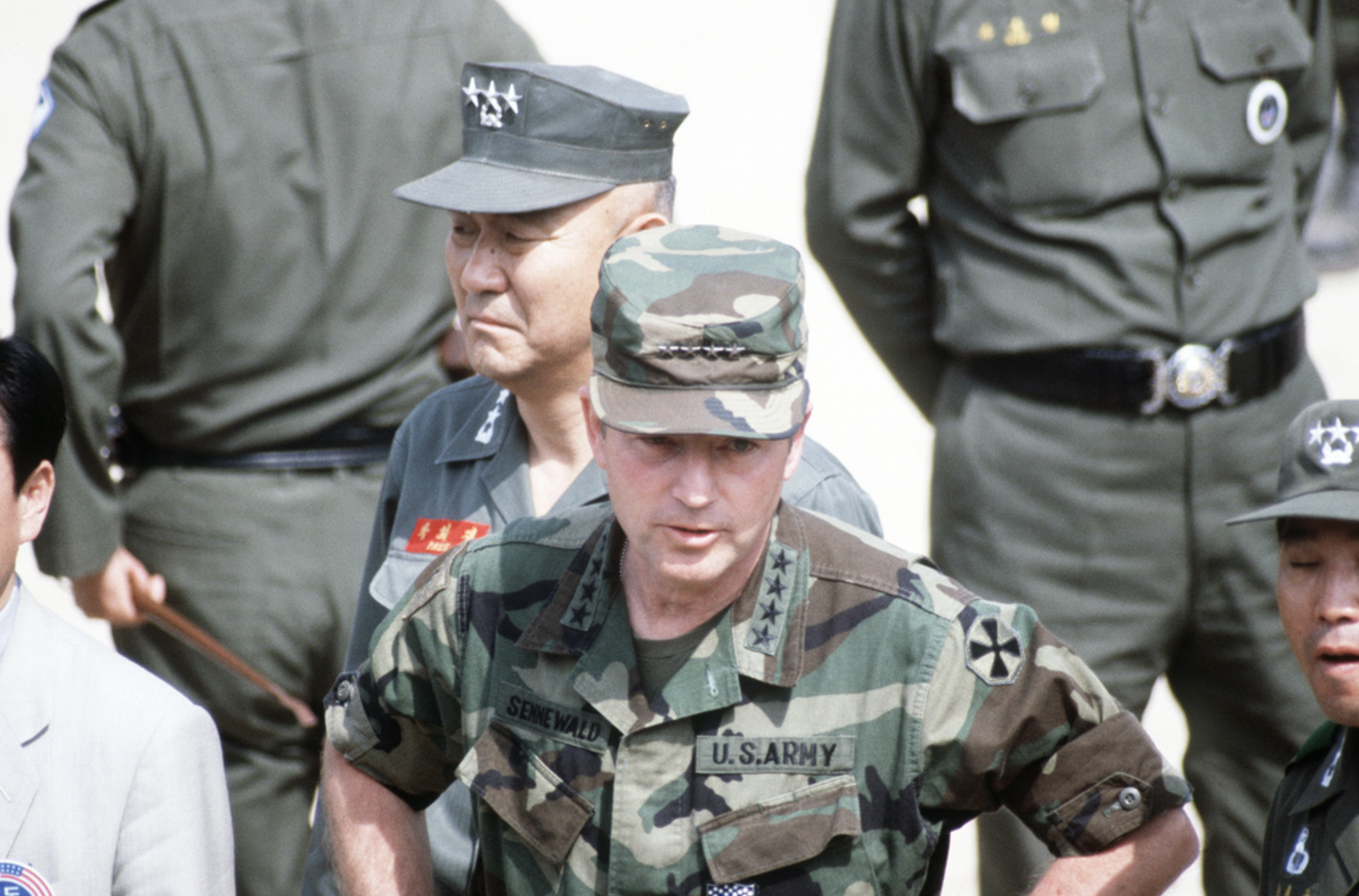
Park’s death was the culmination of weeks of deepening unrest in Seoul, Pusan and other Korean cities set off by intense labor strife and angry student and political opposition to Park’s dictatorship. That unrest, in turn, was the driving force for a rolling military coup led by Chun Doo Hwan, an up and coming general who happened to be in charge of military intelligence at the time of the assassination. Chun, who was trained at US Special Forces schools and led Korean soldiers deployed as US mercenaries during the Vietnam War, feared that the ROK’s senior generals were incapable of handling the rising calls for democratization and end to military role in politics.

Chun’s takeover began in December 1979 with an armed attack on the Seoul garrison by troops pulled by Chun from the border with North Korea, where they were part of a joint command with the US Army that was supposed to be the first line of defense against an invasion from the North. The action enraged the US general in charge of the command, John Wickham, as well as the US ambassador, William Gleysteen, who together watched the events from a bunker in the US Embassy.

Over the next five months, as US officials grew increasingly alarmed, Chun and his military allies gradually tightened their control over the country through intensified repression against democratic activists. Their takeover culminated with the declaration of full martial law in May 1980 and the bloody suppression of a student and citizen uprising that followed in the southwestern city of Kwangju. After hundreds of people were shot and bayoneted by elite Special Forces troops sent to subdue the rebellion, a ragged army of students and ordinary citizens drove the military out of their town and held it for seven days – until President Carter approved the use of Korean troops from the joint command to put it down.

KWANGJU: TURNING POINT IN THE COLD WAR IN ASIA

Today in Korea, the Kwangju People’s Uprising has come to symbolize the beginning of the country’s democratic revolution that culminated in 1989 with the election to the presidency of longtime dissident Kim Dae Jung. Chun and his co-conspirator in the coup, former president Noh Tae Woo, were both convicted of treason and murder for the directing the suppression of the Kwangju Uprising, but were both pardoned and freed by Kim Dae Jung as an act of conciliation.

Kwangju is important in the annals of U.S. foreign policy because it signaled the end of the special US relationship with the South forged in the aftermath of World War II. Carter’s decision to back the military over the public clamoring for democracy marked, to many South Koreans, the final betrayal in a long history of siding with dictators in the name of US national security and military dominance in Asia.  Just like the Soviet suppression of Hungarian independence in the summer of 1956 expose the thuggish face of Soviet military power, the US backing of the military strongman Chun Doo Hwan and his supporters ripped the face off America’s supposed commitment to human rights and the rule of law.

The Korean crisis of 1979 to 1980 also exposed the very hardline policies possible in the Democratic Party and its key players at the time, namely Richard Holbrooke, now a high-ranking official in Hillary Clinton’s State Department, and Zbigniew Brzezinski, who has won a certain claim to fame in fashionable leftist circles in Washington for his opposition to the War in Iraq and his critique of the Bush/neocon foreign policies.

Holbrooke and Brzezinski were instrumental in persuading Carter that his only alternative in South Korea was to support Chun over the democratic aspirations of the Korean people. To these men, the preservation of the US “interests” in South Korea – which included nuclear weapons (since removed), the forward basing of 35,000 US combat troops (most of them still there) and a huge market for US banks and defense contractors (still) - was paramount, and far outweighed any support for the political and democratic impulses of the Korean people. Then as now, the North Korean “threat” was used as an excuse for the tough policies.

Put in a global context, the Korean crisis occurred at a momentous time for the United States: just weeks after the Iranian revolution that toppled the Shah of Iran, the CIA-backed dictator who had been the centerpiece of the US posture in the Middle East. As readers will see in the stories that follow, the prevention of “another Iran” in East Asia – that is, an anti-US revolution installing an unfriendly government, preceded by the break-up of the military – was the other driving force for Carter, Holbrooke and Brezezinski.

THE CHEROKEE FILES

During the 1990s, I obtained and released a set of declassified US government documents that showed how closely Carter and his Democratic hardliners supported the South Korean army in its refusal to allow a true civilian government to form in the aftermath of Park’s assassination in 1979. Their actions, in the name of US national security interests, helped pave the way for nearly eight more years of repressive military rule in South Korea, sparking a wave of anti-Americanism in that country that has never ebbed.

Indeed, former president Roh was elected precisely because he represented the new, independent spirit of South Korea. After his death, he was quoted often in the US press for insisting that the ROK was no longer subservient to the United States and would “kow-tow” no longer. For his stance, Roh was treated with contempt by the Bush administration; many Koreans noticed when the current president Lee was invited last year to spend time with Bush at Camp David – a gesture never afforded the independent Roh. It is important to keep these events - and the complicated politics of South Korea- in mind as we contemplate how to approach the current nuclear standoff with North Korea.

The declassified documents – which went by the codename Cherokee - became the heart of a series of stories I wrote for the Journal of Commerce and South Korea’s Sisa Journal in 1996. In Korea, they caused a sensation; the day after wire reports about my revelations were published, students demonstrated at the US Embassy in Seoul. For days, reports ran in Korean newspapers about Carter’s decision – outlined in key documents, as described below – to give a green light to Chun when he told Gleysteen that he might have to use force to end a series of demonstrations that had tied up Seoul for days.

The documents were so significant in changing historians’ perceptions of U.S. actions at that time that two Korea experts, Chalmers Johnson and Don Oberdorfer, wrote about them extensively in books they wrote about contemporary U.S.-Korean relations.

But outside of my own newspaper, virtually nothing appeared in the US press about the documents and what they said about US policy. Both the New York Times and the Los Angeles Times were convinced by US officials that the revelations were nothing new and not worth of reporting (I was told this much later by reporters from both papers and will explain in more detail in a separate post soon).

I begin this series by rerunning my original pieces from Sisa Journal, which were much lengthier than what I wrote for the JOC and include significant excerpts from the declassified cables. In the coming weeks and months, I will update the story with new documents I’ve obtained over the past ten years from the CIA as well as some documents that were released to me in full after being heavily censored when I initially obtained them. I begin with the initial story about the revelations in the Cherokee Files.

THE CHEROKEE FILES:
NEW DOCUMENTS REVEAL U.S. POLICY MAKING DURING KWANGJU
(First published as Part One of a series in Sisa Journal, February 1996)

By TIM SHORROCK

Senior officials in the Carter administration approved South Korean plans to use military troops against pro-democracy demonstrations ten days before former General Chun Doo Hwan seized control of the country in a May 17, 1980, military coup, according to newly released U.S. government documents.

U.S. officials also knew Chun’s contingency plans included the deployment of Special Warfare Command troops  to Seoul and Kwangju, the documents show.

Two brigades of those Special Forces were later held responsible for killing hundreds of people in a massacre in Kwangju that drew worldwide attention. In 1996, Chun and his chief lieutenant in the operation, General Noh Tae-Woo, were convicted by a Korean court of murder and treason in connection with the crimes.

The declassified documents contradict key statements made in a 1989 State Department “White Paper” on U.S. actions during the Kwangju Uprising. In that paper U.S. administration of President George H.W. Bush declared that the Carter administration had been alarmed by Mr. Chun’s threats to use the military against the nationwide demonstrations in May 1980 and did not know in advance that Special Forces were being sent to Kwangju. That absolved the United States of any guilt in the violence in Kwangju, according to the U.S. government.

“We stand by the integrity of that report and our actions,” the State Department said in an official statement, provided to me in response to this story, which was originally published in the Journal of Commerce in February 1996.

The declassified documents are part of a collection of 2,000 diplomatic and military cables from the State Department and the Defense Intelligence Agency obtained by this reporter under the Freedom of Information Act.

HOW THE CHAIN WAS ESTABLISHED

The chain of secret cables related to the Korean crisis of 1979 and 1980 were given the code name “Cherokee.” Most of the documents are cables between the U.S. Embassy in Seoul and the State Department in Washington. They provide a detailed, inside look at the decisions made at the highest levels of the U.S. government during that time.

According to the cables, ten days after the assassination, Secretary of State Cyrus Vance set up a secret policy-making group to monitor the situation in Korea. Departing from the standard secrecy in such situations, Mr. Vance established a special communication link code named “Cherokee.”

“In order to assure candid high-level exchange of information and recommendations on evolving ROK political situation and how USG can best encourage positive outcome, we are establishing a privacy series with this message,” Mr. Vance wrote in his cable, which is dated Nov. 6, 1979.

Direct distribution of the cables, he said, will “include only” the Secretary of State, Deputy Secretary Christopher and Assistant Secretary Holbrooke, who was instructed to handcarry the cables to the National Security Council and, “as necessary, inform other key officials.” At the U.S Embassy in Seoul, only U.S. Ambassador William H. Gleysteen had access to the cable traffic; indeed, he wrote many of its most interesting updates.

The cables with the highest classification were labeled “NODIS,” which means no distribution outside of highly classified and approved channels.

From the first day of the crisis, Mr. Gleysteen recalled in a long interview with me in 1996, Korea policy was handled by a small group of officials from the White House and State Department. In addition, the Central Intelligence Agency and the Pentagon were “brought in at high levels,” he said.  The secrecy, “a normal proclivty in a crisis,” was necessary to deal with the complex military, economic and political issues at stake in Korea, he said.

According to Mr. Gleysteen, a veteran diplomat who served in the Ford Administration as Deputy Secretary for East Asian and Pacific Affairs, the Korean crisis of 1979 to 1980 was one of the few times in his career when inter-agency policy ran smoothly. One reason for that, he said, was because both the State and Defense departments had good access to President Carter, who “was following events as a telegram reader.” At the White House, “you just pushed the Korea button and the door opened,” he recalled.

CRISIS BEGAN WITH PARK ASSASSINATION; U.S. ACTED QUICKLY

For the United States, the Korean crisis began with the assassination of President Park Chung Hee in October 1979 and ended at the end of 1980, when Mr. Chun became president and was invited to the White House by President Reagan in exchange for commuting the death sentence of dissident, and later president, Kim Dae Jung.

Overall, the Cherokee documents paint a devastating portrait of an administration divided between its public commitment to human rights and its desire not to disrupt important U.S. military and economic ties in South Korea. According to the documents:

•    The U.S. assurances to Mr. Chun that it would not  oppose contingency plans to use military troops were made by Ambassador Gleysteen on May 8, 1980, with the advance approval of Mr. Christopher and Mr. Holbrooke. Mr. Christopher was Secretary of State during the Clinton administration, where Mr. Holbrooke served as President Clinton’s chief negotiator on Bosnia. “In  none of our discussions will we in any way suggest that the USG opposes ROKG contingency plans to maintain law and order, if absolutely necessary, by reinforcing the police with the army,” Mr. Gleysteen reported to Washington in a secret cable on May 7, 1980, shortly before a crucial meeting with Mr. Chun and top aides to acting president Choi Kyu Ha. “We agree that we should not oppose ROK contingency plans to maintain law and order,” Mr. Christopher cabled back the next day. He added that Mr. Gleysteen should “remind Chun and Choi of the danger of escalation if law enforcement responsibilities are not carried out with care and restraint.”

•    U.S. officials in Seoul and Washington were aware long before Kwangju that the Korean military was planning to use Special Forces trained to fight behind the lines in a war with North Korea against unarmed student and worker protests. U.S. knowledge of the Special Warfare Command movements was spelled out by Mr. Gleysteen in a secret cable on May 7, entitled “ROKG Shifts Special Forces Units.” In the cable, he informed Washington that the Korean military had informed U.S. commanders in South Korea that it was moving two Special Forces brigades to Seoul and the area of the Kimpo Airport “for contingency purposes” and “to cope with possible student demonstrations.” They included the 13th and 11th brigades of the Special Forces. “Clearly ROK military is taking seriously students’ statements that they will rally off campus on May 15 if martial law is not lifted before that date,” Mr. Gleysteen concluded.

•    More detailed information, including the deployment of Special Forces to Kwangju, appeared in a Defense Intelligence Agency cable to the Department of Defense Joints Chiefs of Staff on May 8. It stated that all Korean Special Forces brigades “are on alert” and noted that the 13th SWC brigade had been moved to the Seoul area on May 6 while the 62nd battalion of the 11th SWC brigade had “moved into the Seoul area” on May 7. “Only the 7th brigade remained away from the Seoul area,” the cabled stated. It “was probably targeted against unrest at Chonju and Kwangju universities.” According to the DIA cable, all Korean Special Forces units “had been receiving extensive training in riot control, in particular the employment of  CS gas had been stressed.” CS gas is a virulent form of tear gas banned in many countries and considered by some military specialists to be a form of chemical warfare.

The Carter administration decided to support Mr. Chun’s suppression of the Kwangju Uprising on May 22 at a high-level White House meeting. The decision was made after the U.S. Embassy in Seoul and military intelligence had filed extensive reports on the massacres that took place in Kwangju on May18 and May 19.

The participants in this extraordinary meeting, according to the secret minutes obtained from the National Security Council, included Secretary of State Edmund Muskie; Mr. Christopher; Mr. Holbrooke; President Carter’s National Security Adviser Zbigniew Brzezinski; CIA director Admiral Stansfield Turner; Donald Gregg, the NSC top intelligence official for Asia and the CIA Station Chief in Seoul in the 1970s; and U.S. Defense Secretary Harold Brown.

After a full discussion of the situation, “there was general agreement that the first priority is the restoration of order in Kwangju by the Korean authorities with the minimum use of force necessary without laying the seeds for wide disorders later,” the minutes state.

“Once order is restored, it was agreed we must press the Korean government, and the military in particular, to allow a greater degree of political freedom to evolve.”

The U.S. position was summed up by Dr. Brzezinski: “in the short term support, in the longer term pressure for political evolution.”

As for the situation in Kwangju, the group decided that “we have counseled moderation, but have not ruled out the use of force, should the Koreans need to employ it to restore order.” If there was “little loss of life” in the recapture of the city, “we can move quietly to apply pressure for more political evolution,” the officials decided.

STATE DEPARTMENT REACTION

The statements in the new documents appear to contradict the 1989 White Paper. In May 1980, that report said, “U.S. officials were alarmed by reports of plans to use military units to back up the police in dealing with student demonstrations.” As for the Special Forces, the United States “had neither authority over nor prior knowledge of the movement of the Special Warfare Command units to Kwangju,” it concluded.

In a series of interviews, the State Department acknowledged an “apparent discrepancy” between the White Paper and the statements in the secret cables. But the agency strongly defended the integrity of the 1989 study.

“Its basic conclusions are unassailable and unimpeachable,” a State Department official said of the White Paper. “There are no new lessons to be learned.”

The official said the State Department may not have had “every document that ever pertained to this” available when it wrote the report, but added “there is not a great deal of enthusiasm to reopen the report.”

Asked if, by approving the contingency plans, the Carter administration may have given Mr. Chun a green light for his military coup on May 17, the State Department official said “the word approved is not appropriate.” Under the rules of the Combined Forces Command, he said, South Korea must give prior notice before using troops under joint command but has “sovereign control” over those troops once they are released. “The U.S. can only review their readiness to face the North Korean threat,” he added.

The official said the documents describing movements of the Special Forces “would not have raised a red flag” within the Carter administration because the use of military troops to control against student demonstrations was considered the norm in South Korea. Even acts of brutality, such as beatings or use of CS gas, were not considered unusual, he said.

“The way they handled law and order was rough,” the official said. “But we had a way of tolerating it by that time. This was not an aberration or a sudden departure from the norm. It was the norm.” However, nobody in the Carter administration could have anticipated that such actions would lead to the brutality displayed in Kwangju, the official said.

“That was an unspeakable tragedy that nobody expected to happen,” he said. “When all the dust settles, Koreans killed Koreans, and the Americans didn’t know what was going on and certainly didn’t approve it.” The State Department, he said, continues to believe that the United States “has no moral responsibility for what happened in Kwangju.”

Mr. Gleysteen, who retired from the U.S. foreign service in 1981 and died in 2002, told me that the United States approved the Korean contingency plans to use the military because South Korea would have faced total chaos without it. He strongly denied any knowledge that Korean Special Forces were to be used against student demonstrators.

“The U.S. understood at the time that no government would allow law and order to break down,” he said during an interview in New York. “But we added that how this was done was critically important.” In any case, Mr. Gleysteen said, the Special Forces responsible for the rampage in Kwangju were “employed without the knowledge of the United States…I had no idea whatsoever they were being used for the suppression of student demonstrations.”

Mr. Gleysteen said he could not remember seeing the DIA cables on the Special Forces troop movements, but added that “even though they were not under our command, we did know usually where they were.” Nevertheless, U.S. officials had no indication they would be sent to Kwangju with orders to kill, he said.

“Given that I never believed that something like Kwangju would ever happen, that there would be soldiers sent with those kinds of orders,” such a cable “would not have been surprising information,” Mr. Gleysteen said. It was “absolutely unknown to the United States, either through military or civilian channels,” that the Special Forces would open fire or use bayonets on peaceful demonstrators, he said.

After Kwangju, Mr. Gleysteen said, he was “highly critical of the unwarranted cruel actions” and reacted strongly to the arrests of Kim Dae June and other dissidents.

FORMER CIA STATION CHIEF ON THE CRISIS

Donald J. Gregg,  the former U.S. ambassador to Seoul who headed the Asian intelligence desk at the National Security Council under President Carter, said in an interview with me that he does not recall seeing “anything special” about special forces deployments prior to Kwangju.

“That was part of my job, looking at the flow of intelligence, but I read it after it was distilled by military intelligence or the CIA,” Mr. Gregg said. Asked about the DIA documents stating that Special Forces were moving to Kwangju, “maybe that didn’t get the attention it deserved, or maybe it was judged unreliable,” he said.

Mr. Gregg was the CIA station chief in Korea from 1973 to 1975 and had a long career in U.S. intelligence. With military intelligence, “you always have to be sure of the quality of the information and the source,” he said. In any case, Mr. Gregg said he could not be sure if the DIA information on the Special Forces movements “reached the policy-thinking levels”  at the embassy or the White House.

Asked about the May 22 meeting, which he attended, Mr. Gregg said “our real concern was that the North not use this as a pretext for intervention. Once the fat was in the fire, Brzezinski said we can’t do anything until things get calmed down in Kwangju.” After it was clear the Korean 20th Division had retaken Kwangju with a minimum of force, the Carter administration continued its policy of pushing Mr. Chun towards moderation, he said.

Throughout this period, Mr. Gregg said, the Carter administration was “concerned about sending the wrong signal to North Korea. That was the prism through which we always saw the events of this government.”

Critics of U.S. policy in Korea sharply disagreed with the assessments of Mr. Gleysteen and Mr. Gregg.

“What you find is a logic that develops that they weren’t going to do a thing to Chun Doo Hwan,” said Bruce Cumings, a leading expert on the Korean War, after reading Mr. Gleysteen’s May 8 cables and the DIA descriptions of the Special Forces movements. “In the Korean context, these documents could be incendiary.”

Mr. Cumings, who has written extensively about the foreign policy of the Carter administration, said the Cherokee documents read very much like the secret policy papers he collected for his two-volume history on the origins of the Korean War. “Once again, it shows that the intelligence people are much closer to the people in power,” he said. For people like Mr. Holbrooke and Mr. Brzezinski, “its always security first, security second and security third,” said Mr. Cumings. “But what they always mean is, U.S. security.”

Pat Derien, who was President Carter’s Assistant Secretary of State for Human Rights, said Mr. Gleysteen’s statements to Mr. Chun were “a green light as far as I could see then and as far as I can see now.” She was particularly critical of Mr. Holbrooke and others who argued that national security concerns limited the choices the United States had in South Korea.

“I’m virtually speechless when I think of them pandering to these dictators and the excuses they gave for everything,” she said.

Ms. Derien, who had sharp disagreements with Mr. Holbrooke over Korean policy during her tenure at the State Department, said “national security hysterics” frequently determined the direction of U.S. policy.

Towards the end of the Carter administration, she said, the officials concerned with security issues “captured the decision-makers, including the president and the secretary of state, threatening them with endangering national security.” That shift was responsible for the policies in Korea as well as President Carter’s decision at the end of his presidency to send arms to the government of El Salvador, she said.

BACKGROUND

The Korean crisis of 1980 occurred at a time when the United States was overwhelmed with the hostage crisis in Iran and deepening tensions with the Soviet Union. They coincided with a remarkable turnaround in U.S.-Korean relations following years of turmoil over security and human rights issues.

In the months leading up to President Park’s assassination in October 1979, the Carter administration was deeply involved in trying to restore U.S.-Korean security and military ties. Those ties had been tarnished by the Koreagate scandal of the mid-1970s, when the Korean CIA was involved in a covert attempt to influence U.S. legislation by bribing U.S. lawmakers, and President Carter’s aborted plan to withdraw U.S. ground troops from South Korea. They were also marred by President Park’s authoritarian policies under the Yushin system, which were sharply criticized by President Carter as part of his emphasis on human rights.

By February 1979, U.S-Korean relations were back on course. The key goals and objectives of the United States were laid out in a secret cable from Secretary Vance to the U.S. Embassy in Seoul and the Pacific Command in Hawaii. The U.S. goals, said Mr. Vance, were peace and stability on the Korean peninsula, gaining a “maximum U.S. share of economic benefits from economic relations with (an) increasingly prosperous South Korea;” and “improvement of the human rights environment  through evolution of a liberal, democratic political process,” in that order.

Despite the tumultuous events of the next 18 months, those policies did not change.

In June 1979, after extensive negotiations between Washington and Seoul, President Carter visited South Korea and met with President Park. During that visit, President Carter declared an end to his troop withdrawal policy and the two countries agreed to force closer military ties to counter what was perceived as a growing Soviet and North Korean military threat. President Park responded by relaxing some political controls.

The political unrest that erupted in the fall of 1979 and the shocking assassination of Mr. Park on October 26, 1979, disrupted those plans (see sidebar below). The events also created a sense of panic within the administration that, at a time of rising tensions with Iran and the Soviet Union, a political confrontation in South Korea could spark an explosion and precipitate a third crisis point in the world. Above all else, U.S. officials said repeatedly, the United States must avoid another Iran in Korea.

Ensuring that political instability in South Korea did not trigger another crisis point for the United States became the overriding policy goal throughout the Chun period. U.S. officials expressed that policy by dealing with Mr. Chun at arm’s length and occasionally expressing to him their dismay at his actions. At the same time, the Carter administration grew increasingly wary of the opposition’s tactics and tried hard to persuade dissidents not to press too hard for democratic change.

HOLBROOKE’S ROLE

The deepening sense of anger and frustration was echoed in several cables to Seoul from Mr. Holbrooke, who presided over U.S. Asia policy in the Carter administration. The cables convey his disgust for South Koreans who did not share his concerns that maintaining stability was essential for U.S. national security.

For example, in a Cherokee cable dated Dec. 8, 1979, Mr. Holbrooke asked Mr. Gleysteen to send a direct message to Korean Christians that they should not expect long-term support for their struggles. Mr. Holbrooke wrote the cable after a period of discussing the Korean situation with Congress, including top Democrats involved in East Asian affairs, Sen. Sam Nunn, D-Ga., and Sen. John Glenn, D-Ohio.

“We have their full support at this time,” Mr. Holbrooke wrote. “Their attitudes, like everyone else, are dominated by the Iranian crisis, and, needless to say, nobody wants ‘another Iran’ - by which they mean American action which would in any way appear to unravel a situation and lead to chaos or instability in a key American ally.”

Mr. Holbrooke said he was encouraged by “many of the things the Korean leadership has done.” But he added that “certain events have caused us to share our concern over the potential polarization that exists as a result of the actions of what appear to be a relative handful of Christian extremist dissidents.”

To deal with those “hardliners” Mr. Holbrooke proposed a “delicate operation designed to use American influence to reduce the chances of confrontation and to make clear to the generals that you (Gleysteen) are in fact trying to be helpful to them provided they in turn carry out their commitments to liberalization.”

The United States, Mr. Holbrooke said, should send a direct message to the dissidents that “in this delicate time in Korean internal politics, the United States believes that demonstrations in the streets are a throw-back to an earlier era and threaten to provoke retrogressive actions on the part of the Korean government.”

“Even when these meetings are in fact not demonstrations but rather just meetings in defiance of martial law, the U.S. government views them as unhelpful, while martial law is still in effect,” Mr. Holbrooke said.

Mr. Gleysteen was shown this cable in his interview with this reporter, and asked if he had followed up on Mr. Holbrooke’s advice.

“No, that was too tricky,” Mr. Gleysteen replied. “This was an armchair suggestion from Washington, something we just couldn’t do.”

Nevertheless, throughout this period, Mr. Gleysteen continued to press Korean dissidents to take a moderate approach to the military and avoid confrontation.

While warning the military to be tolerant, “on the left, we tried to get the message across to the moderates that they should keep down their inflammatory actions,” Mr. Gleysteen explained. This effort was so successful, he said, that by December 1979, “people were beginning to talk about a ‘Seoul Spring’” as Kim Dae Jung was released from prison and other dissidents were freed to take part in political activities.

DECEMBER 12 INCIDENT

Even the December 12 incident, when Mr. Chun and Noh Tae Woo seized control of the military command, did not dampen the U.S. enthusiasm that democratic change might come to South Korea.

To be sure, Gen. Chun’s deployment of Korean troops on the DMZ without the permission of the U.S.-Korean Combined Forces Command deeply angered the Carter administration and U.S. military officials in Korea. “There was highest level concern over the apparent violation of the CFC structure and over any backtracking from movement towards civilian governments,” Mr. Holbrooke cabled Mr. Gleysteen in a Dec. 18, 1979, message signed by then-Secretary of State Cyrus Vance.

But the Carter administration saw the incident as a temporary setback, not a dangerous signal that Gen. Chun was preparing the way for a military takeover. According to the cable, Mr. Holbrooke’s primary concern was that dissidents might use the Dec. 12 incident as an excuse to “take the offensive” against the Choi government. “If that occurred at a time of instability within the military, North Korea might be tempted “to test the waters for meddling in the south,” he said.

With that in mind, Mr. Holbrooke instructed his ambassador to extract a promise from President Choi for eventual democratization, even if the promise was vaguely defined and meant only for public consumption.

If President Choi demurred, Mr. Holbrooke argued, “you could even point out, if you were a very cynical person, that setting a date now does not necessarily mean that this date will be kept…but that setting a specific date is more important than exactly when that date is.”

Apparently, President Choi agreed to that reasoning. On December 19, according to a classified cable, Korean ambassador Kim Yong-Shik called on Mr. Holbrooke and reassured him that the political process would continue. Mr. Kim’s actual statements are censored by the State Department, but Mr. Holbrooke’s reply is not.

According to the cable, Mr. Holbrooke said he “found the ROKG message reassuring and hoped that it would be possible to carry out the commitment to broadly based political development. He then “assured Amb. Kim that the USG would not publicly contest the ROKG version of recent events, but he would not wish to see further military changes of command ‘Korea style.’”

By making that assurance, Mr. Gleysteen said in his interview, the United States was saying “we won’t argue about who did what to whom.” Although U.S. policy makers, including Mr. Gleysteen himself, had “the deepest suspicions” about Mr. Chun, “we still had that hope that he could be constrained by the total situation to behave himself in a capable manner.”

Mr. Gregg said U.S. military officials were concerned that a hard line towards Mr. Chun would damage military relationships strained by the Carter administration’s troop withdrawal policies.

“These were military to military matters, ” Mr. Gregg said.  President Park, he said, had been deeply threatened by the U.S. pullout from Vietnam. “He was a hardened man, and saw us as a very  unreliable ally. He really wondered if we had any staying power.” Those feelings were shared by Mr. Chun and his closest advisers, many of whom had served in Vietnam, Mr. Gregg said.

Those views were not entirely shared within the Carter administration, however. According to Mr. Gleysteen, some administration officials pushed for sanctions to pressure the Chun group to relax its grip on power. The choices, he said, ranged from shifting U.S. military forces in Korea to stopping the supply of military equipment.

“Our concern was how these moves would be interpreted by North Korea,” he said. “I looked at this as a highly dangerous type of thing.”

He expressed his alarm in several cables.

DESPITE THE COUP, CLOSE US-KOREAN MILITARY TIES

“We must not take sanctions, symbolic or otherwise, against the ROK which would in any way diminish ROK and US/ROK defense capabilities, and we must also be careful not to do anything which would appear to the Korean public as anti-Korean, as opposed to anti-December 12,” Mr. Gleysteen wrote in a Dec. 29 cable. Specifically, he said he opposed holding back on the co-production of F-5 fighter planes or refusing to sell F-16s. Such an action “would violate all these precepts and I would strongly oppose playing around with either of them.”

In the end, nothing was done to disrupt U.S.-Korean military ties, with one exception: about two weeks before the Kwangju Incident, the annual U.S.-Korea Security Consultative Meeting was put off for one year.

The same logic was applied to economic sanctions. By late 1979, with U.S. aid no longer a factor in the Korean economy, the only influence the U.S. Embassy had in Seoul was its advice to U.S. and foreign business, particularly U.S. banks, Mr. Gleysteen said. But sanctions applied in the economic field, such as withholding loans or credit, would “have had the same impact on society and North Korea” as military sanctions, Mr. Gleysteen explained in his interview.

“The victims would have been business people and workers in Korea,” he said. “This is always a problem on the human rights side - that the sanctions would hurt the wrong people.” Therefore, the choice was made to treat the Chun group “by remaining aloof” from Mr. Chun and continuing to pressure the generals to reform, Mr. Gleysteen said.

“We really couldn’t come up with anything better than we did,” he explained. “But it in turn was better than it sounds and it really was reasonably effective. I mean Chun squirmed. He was very uncomfortable under this policy. He had a hard time explaining to his officers - when he’d say things were fine, they’d say but, but, but. This actually worked reasonably well.”

Dealing with Mr. Chun in this way, Mr. Gleysteen said, was a “distasteful process, and he hated me for it.” Several times, Mr. Chun called Mr. Gleysteen “governor-general,” he recalled.

Ms. Derian, the human rights official, scoffed at the idea that Mr. Chun was threatened by this policy. “This was not a slap of the wrist, it was more like a wave of the hanky,” she said. “I find the whole thing not credible.”

THE END GAME

By April 1980, despite continuing signs that Gen. Chun was readying a full-scale military takeover, the Carter administration appeared pleased with the situation in Korea.

The administration’s views were expressed in April to ROK Foreign Minister Park Tong Jin, who visited Washington and met with Secretary of State Vance, Mr. Holbrooke and other key officials. In an April 16 cable describing that meeting, which primarily covered events in Iran, Secretary Vance expressed his “great satisfaction over the many positive developments” since his visit to Seoul during President Park’s funeral in November 1979.

“Noting that General Wickham and Ambassador Gleysteen have instructed their people in Korea to maintain very good relations with their counterparts, including the ROK military, (Mr. Vance) expressed the hope that similar guidance is in effect on the Korean side and that there will be the fullest confidence and mutual cooperation.”

Even with Mr. Chun’s assumption of powers at the KCIA in early April, the Carter administration had returned to a “business-as-usual” stance with the Korean government.

As political tensions inside South Korea mounted in March and April and hundreds of thousands of students began demonstrating for an end to martial law, Mr. Chun and President Choi began to discuss with Mr. Gleysteen and Mr. Wickham the need to use the military, according to Mr. Gleysteen.

“Chun was saying he was going to behave but he had to have contingencies if things got out of control,” Mr. Gleysteen said. It was in this context that the United States agreed with the contingency plans to use the military, he said.

“There was a certain amount of contradiction in it,” he said. “We recognized he couldn’t lose control of law and order in society. On the other hand, using soldiers was very dangerous and if there was any shooting, that would bring the house of cards down.”

Mr. Gregg said the Carter administration was generally satisfied with how Mr. Chun handled the student demonstrations. “I remember the general feeling,” he recalled. “There was real apprehension when the riots broke out in Seoul. Chun was a very tough man. So there was relief when they were moderately handled.”

Even the behavior of the Special Forces in the October 1979 demonstrations at Pusan and Masan - when the Black Berets were quite willing to “break heads,” according to the DIA documents - did not indicate the severity of what happened in Kwangju, Mr. Gleysteen said.

“That was nothing really egregious by local standards,” he said. “We had no preview of Kwangju, of what amounted to very cruel brutality…It was very much out of line with Korean military behaviour in our experience.” In fact, the initial reports from Kwangju were so horrific that “there was some disbelief in our minds” that it had happened, he said.

Those first reports were recorded in a May 19 cable to Washington, based largely on the observations of a U.S. Embassy information officer in Kwangju. “Rumors reaching Seoul of Kwangju rioting say special forces used fixed bayonets and inflicted many casualties on students,” Mr. Gleysteen wrote. “Some in Kwangju are reported to have said that troops are being more ruthless than North Koreans ever were.”

Two days later, however, the tone of Mr. Gleysteen’s messages had changed. “Unquestionably…a large mob has gained temporary run of the city, and the authorities face series of very difficult options,” he wrote.

Later that day, he wrote that “while military will probably restore order using considerable force, sufficient damage has been done to create scars which will last for years.”

That night, as President Carter’s security advisers prepared to discuss Kwangju at the White House on May 22, Mr. Gleysteen reported that the “massive insurrection in Kwangju is still out of control and poses an alarming situation for the ROK military who have not faced a similar internal threat for at least two decades.” He estimated that “at least 150,000 people are involved” and said “there has been great destruction.” He said the Korean military as “concentrating defense on two military installations and a prison containing 2,000 leftists…The December 12 generals obviously feel threatened by the whole affair.”

It is clear from the Cherokee cables that the Carter administration had decided by May 22 that military force was necessary to retake Kwangju from what the United States considered a “unruly mob.”

In a meeting with the foreign minister that day, Mr. Gleysteen described “the extent to which we were facilitating ROK army efforts to restore order in Kwangju and deter trouble elsewhere,” according to a May 22 cable. “We had not and did not intend to publicize our actions because we feared we would be charged with colluding with the martial law authorities and risk fanning anti-American sentiment in the Kwangju area.”

In another cable that day, Mr. Gleysteen said he and General Wickham “have been assured by the military hierarchy” they would encourage public distribution of the official U.S. statement from the day before urging “maximum restraint” on both sides. By this time, however, military action had apparently already been approved because the military hierarchy also told Mr. Gleysteen and Gen. Wickham they “will not undercut us by taking forceful action in Kwangju for at least two days unless the situation goes completely sour.”

KWANGJU: POINT OF NO RETURN

By this time, Mr. Gleysteen was convinced the situation in Kwangju had reached a point of no return.  In a cable sent at 10 p.m., he reported that the Kwangju “rioters” had increased to 150,000 and were seizing hundreds of vehicle and thousands of firearms. Kwangju, he said, “has turned completely into a scene of horrors.”

“If peaceful methods fail” to end the disturbance, Mr. Gleysteen concluded, the “government has 20th Infantry Division, plus airborne and special forces units, on alert in Cholla Namdo.”

U.S. approval of the military action - which involved allowing the 20th Division to be deployed from the CFC in Seoul - was agreed upon at the May 22 White House meeting of the newly created Policy Review Committee on Korea. It took place at 4 p.m. on May 22 in Washington, which would have been early in the morning of May 23 in Seoul.

After deciding, in Mr. Brzezinski’s words, on “short term support” for Mr. Chun and “in the longer term pressure for political evolution,” the White House group discussed pending visits by key U.S. officials to Seoul, including one in early June by John Moore, the president of the Export-Import Bank.

“The consensus of the group was that it might be a mistake at this time to send a negative signal to the Koreans by cancelling another visit,” the group decided, according to the notes.

On May 23, hours after the White House meeting, Mr. Gleysteen paid a call on Acting Prime Minister Park to communicate the U.S. position. In the discussion, Mr. Gleysteen reported back, “I said that the policy decisions of May 17 had staggered us.” However, the two officials “agreed that firm anti-riot measures were necessary, but the accompanying political crackdown was political folly and clearly had contributed to the serious breakdown of order in Kwangju.”

Mr. Gleysteen also noted that the United States was “doing all we can do contribute to the restoration of order,” and cited the official statements issued in Washington the day before and “our affirmative replies when asked to ‘chop’ CFC forces to Korean command for use in Kwangju.”

Over the next few days, Mr. Gleysteen said, he tried to seek a compromise by urging restraint on the part of the people of Kwangju and asking the government to apologize for the killing that took place on May 18 and May 19. But Mr. Gleysteen said he was alarmed by the turn of events inside of Kwangju, particularly when citizens seized arms and emptied one of the local prisons.

“The point is, law and order was gone. It was chaos,” he recalled. “Both sides at that point were rather equivalent.”

As he has said in previous interviews, Mr. Gleysteen defended the U.S. decision to allow the 20th Division to be released from the joint command to enter the city during the early morning hours of May 27. According to Gen. Wickham, he said, the 20th Division had been “very careful and well-behaved” while on martial law duty in Seoul. In addition, “we did not want the special forces used even further, precisely because of what had happened.”

When he received a last-minute request to mediate in Kwangju from a U.S. reporter on the scene in Kwangju, Mr. Gleysteen said the 20th Division was already rolling. In addition, Mr. Gleysteen said he had no idea of the authenticity of the group seeking the mediation decided not to act.

“I grant it was the controversial decision, but it was the correct one,” he said. “Do I regret it? I don’t think so.”

LABOR, POLITICAL UNREST PRECEDED PARK ASSASSINATION

When Park Chung Hee was shot to death in October, 1979, he had ruled South Korea for nearly 18 years. Although the Korean economy had made huge leaps during that time, the government’s heavy hand in the economic planning had been a disaster.  A decision to invest in heavy industry, such as steel and shipbuilding, had led to overcapacity at a time when the world economy was slowing down. Runaway inflation bit deep into workers’ already meager wages, sparking a rise in labor unrest.

Politically, the country was ready for a major change.  The Yushin Constitution, imposed by President Park in 1972, allowed Mr. Park and his political party to rule the country virtually by decree. Dissidents were routinely arrested and tortured. By 1978, students, intellectuals and Christians were pressing for a more open political system that would allow direct elections for president. Workers, meanwhile, began secretly organizing unions and grew increasingly frustrated as President Park’s secret police broke up their meetings and arrested their leaders.

In June 1979, President Jimmy Carter came to Seoul for his first meeting with Park. Within two months, political tensions began to heat up as President Park launched another crackdown. “A real tightening up was taking place,” recalled Mr. Gleysteen, who was ambassador to Seoul from June 1978 to January 1981.

In the fall of that year, tensions reached a climax when a group of textile workers organized a sit-in at the offices of the New Democratic Party headed by Kim Young Sam (who later served as South Korea’s president). After several days of negotiation, President Park ordered riot police to storm the building; in the resulting melee, a young woman worker was killed. An angry Kim Young Sam, in an interview with The New York Times, denounced Mr. Park and said the United States should cut off all ties with him. A few days later, Mr. Kim was expelled from the National Assembly.

“We choked on that,” said Mr. Gleysteen, who was recalled to Washington for consultations to protest the action.

Mr. Kim’s expulsion sparked widespread demonstrations in the port city of Pusan and the nearby industrial zone at Masan. Again, President Park declared martial law and sent tanks and paratroopers to stop the rioting.

Suddenly, in the midst of the turmoil, President Park was assassinated by Kim Jae Kyu, the director of the Korean CIA. In response, the Korean military declared martial law throughout the country. The Carter administration warned North Korea not to intervene and quickly dispatched aircraft carriers and early warning aircraft to the Korean peninsula to back up its threat.


Coming soon to this space…

June 4th, 2009

tim-website.jpg

To my readers: the hiatus is winding down. Postings will come shortly in sudden bursts. Many stories to tell and follow, starting with articles on the U.S. involvement in the suppression of the 1980 Kwangju Uprising - widely known in Asia as South Korea’s Tienanmen. With analysis of the role of Democratic Cold War hardliners still influencing U.S. foreign policy, including Richard Holbrooke. And much more on the privatization of intelligence, the paperback release of my book SPIES FOR HIRE, and the role of contractors in the highly classified Special Operations Command led by the new U.S. commander in Afghanistan, Lt. General Stanley McChrystal.

Keep checking back: many of you have already been digging on my site after being linked to my 2006 story about Kim Jong Il’s middle son, once considered a shoo-in for junior dear leader but dismissed by his father as a girlie man with an overabundance of enthusiasm for Eric Clapton. With Obama now in charge of American foreign policy and the far-right going nuts, there is far too much going on to be silent any more. Stay tuned (with fond thanks to Terri O’Hare of Albuquerque for this cool graphic).

Greenwald, Kincaid, Nader - and me

May 4th, 2009

Glenn Greenwald, one of the best journalists and commentators on the U.S. left, was attacked today in print by Cliff Kincaid, a longtime McCarthyite and deranged right-winger, who has been seeing reds under every bed since he was probably an infant (which in many ways he still is).

Greenwald’s crime, in which his accomplice was Democracy Now! host Amy Goodman, was to accept the first Izzy Stone award from the Park Center for Independent Media in New York. Stone, who wrote under the byline I.F. Stone, was of course one of the greatest independent journalists of all time, and kept the faith from the Great Depression through the “Haunted Fifties” all the way through the 1980s.

For Greenwald and Goodman, the award was well-deserved (I’m proud to be associated with both of them, and have been interviewed for both of their shows - see the links here and here). But accepting the Izzy Stone award was not their only sin, according to Kincaid, who plies his vicious trade at Accuracy in Media; they also appeared on Bill Moyers’ PBS show to speak about their work.

Greenwald responded with his typical verve, telling Kincaid off and proudly associating himself with Stone, who Kincaid (with many of his fellow kooks) believe without substantiation was a Soviet agent. Here’s part of what Greenwald wrote today, as it appeared on Firedoglake:

Izzy Stone was one of the only journalists in America to challenge the government’s lies about the Gulf of Tonkin incident, to oppose the Vietnam War from the start, and to relentlessly highlight the pernicious poison of the McCarthyite witch hunts, which are alive and well in the marginalized and irrelevant fringes of the Right, such as Commentary and AIM.

All of this is interesting to me because I too have been a victim of Kincaid’s attacks. Only my experience with him took place in 1983, when I was just 32 years old, and completely green to the vicious politics of Washington. At the time I was the editor of Multinational Monitor, a magazine owned and controlled by Ralph Nader, who at the time was still a liberal centrist, trembling in fear at the power of the right and the popularity of Ronald Reagan.

My encounter with Kincaid was frightening; but worse still was Nader’s cowardly response. Indeed, that experience more than any other led me to part ways with Nader, who has of course emerged since then as a great (if very late) champion of progressive and leftist causes. He fired me in 1984 over deep political differences, and this incident should tell you why. At least Greenwald has supporters who will back him up today. Back in the early 1980s, it was hard to find people willing to stand up to right-wing zealots. As Phil Ochs once sang, derisively of his type: “Love me, love me, love me, I’m a liberal.”

This is from an unpublished and much longer work entitled NADER AND ME.

How Ralph Nader Capitulated to the Right

By Tim Shorrock

My first run-in with Nader took place just a few weeks after I started my job. It involved three players in Washington’s crazy-quilt political culture — the Institute of Policy Studies and Counterspy Magazine on the left, and the weekly newspaper Human Events on the right. The incident set the stage for nearly everything that followed in the brief relationship between Nader and me.

In January, 1983, I obtained copies of a confidential World Bank document concluding there were serious safety problems with the nuclear power program in South Korea, one of the most ambitious in the world up to that point (and a huge, multi-billion dollar market for the U.S. multinationals Bechtel and Westinghouse, which capitalized on U.S. pressure to beat out their foreign rivals for the contracts). I saw the document as a chance to kill two birds with one stone: draw some press for the magazine and get my tenure as editor off to a good start. So, after getting approval from Nader, I released the document in a press conference with the editors of Counterspy, a local magazine that investigated the CIA.

The event was a success: the story made UPI and the front page of two major papers in Seoul, where the press at that time was under heavy censorship.  After initially denying the report, the Korean government said it would appoint a committee to study nuclear safety. I felt pretty good.

But a day or two after the press conference, Cliff Kincaid, a reporter with Human Events and probably the most notorious red-baiter in Washington barged into my office, demanding to know why I had sat in the same room as the editor of Counterspy, the “murderers of Richard Welch” (Kincaid claimed that in the 1970s, Counterspy had caused the assassination of the CIA station chief in Athens by publishing his name; the charge — repeated frequently by the right — was completely false, but Counterspy never lived it down).

I have a deep aversion to right-wing, neo-Nazi types, and a quick temper to boot.  And, being new to Washington at the time, I had no idea that Human Events was so well read (Reagan supposedly devoured it with his cereal every morning).  So instead of kicking Kincaid the hell out of there, I decided to confront him and defend Counterspy, Multinational Monitor, and my right to say and write anything I damn well chose.

“You’re full of shit,” I told Kincaid.

“Counterspy wants to abolish the CIA.  Do you?” Kincaid shot back.

“Of course.”

“Will you say that on tape?”

“I have nothing to hide.”

And I proceeded to engage Kincaid in a debate on Cuba, the CIA, and God knows what else  in front of a tape recorder.  What I remember most about that interview (really, an interrogation) was Kincaid screaming at me, over and over again in his shrill voice: “Are you a socialist?  Are you a socialist?”  And me saying that, even if I was, he wouldn’t have the vaguest idea of what I was talking about.

Later that afternoon, one of Nader’s aides called me.  Kincaid had called for Nader’s response to my comments, and by the tone of the aides’s voice, I could tell this was Serious Business.  I explained that I had said nothing that could embarrass Nader (he was out of town) but admitted that I was stupid to have talked to Kincaid.  Still, the aide was worried.

“Ralph’s never been red baited before,” he said.  “The business press might pick this up and really hurt him.”

Kincaid’s story, “Nader Establishes Close Links with IPS,” ran on February 19, 1983.  It turned out to be a typical Human Events-style attack on IPS, full of innuendo and guilt by association.

“In a move that could seriously undermine their image as protectors of the ‘public interest,’ Ralph Nader and his raiders have recently been observed making alliances with the extreme left,” the lead read. On January 31, Kincaid reported, Nader held a joint news conference with the Government Accountability Project of IPS “to attack President Reagan.”  He described IPS as “a collection of radicals, Socialists and Marxists” that “has played a key role over the years in apologizing for Communist movements and governments and working to restrict the operations of U.S. corporations and intelligence agencies.”

Kincaid combined that information with the news that the Monitor and Counterspy (”the notorious anti American magazine”) were working together to prove that Nader was indeed in bed with the “far left.”  To drive his point home, he quoted from a stack of Monitor issues I had given him, all published before I had started working there.

The January, 1983, issue–the last one before I took over–had “attacked Jeane Kirkpatrick…and the Heritage Foundation for criticizing U.N. attempts to implement” restraints on multinationals.

Then came the clincher:

“Shorrock,” Kincaid wrote, “indicated that he was a Socialist who favors ‘public decisions about major economic policies.’”  Radical stuff.  But there was more: “Shorrock also said that socialism involves ‘deciding that we don’t want to have our CIA train the Korean CIA to unleash its violence against Korean worker groups to keep their wages low so American multinationals and Japanese multinationals can come in and exploit Korean workers.” (whoa, call the red squad).  Not only that, I had defended Counterspy, called for the abolition of the CIA, believed that “the KGB is not a threat,” and supported “a lot of what the Cuban government does.”

As far as I was concerned, none of these quotes were damaging, some were laughable, and most had been taken out of context.  So I was more than shocked a week later when the next issue of Human Events came out with another headline story: “Nader Disavows Views of His Editor.”

Without even informing me, Nader had instructed his aides to call Human Events with the following statement: “Ralph Nader does not approve of the views expressed by Tim Shorrock, the editor of Multinational Monitor, as reported in Human Events, Feb. 19, 1983.”  Nader told the newspaper that the Monitor was “an independent publication over which Nader holds no control.”  That was an outright lie: Nader hired the staff, personally signed our checks and read each issue before it went to press.  Worse, not once had Nader checked with me as to the accuracy of Kincaid’s quotes; nor had he indicated which statements of mine he disagreed with.  And apparently he saw no reason to defend himself or his colleagues at IPS, which his close friend Marcus Raskin had founded.

I was blown away.  Was Ralph Nader afraid of a shrill right-wing newspaper?  Was this all I could expect when the Monitor,  his own magazine,  was under attack?  Had he really refused to defend his own editor? Furious to the point of quitting, I demanded a meeting with Nader to clarify the situation.  But Nader didn’t want to talk.

“Go back to work and forget about it,” he said.

In 1984, long after I had been fired, I finally realized how gutless and craven Nader had been during this episode from an article by journalist Pat Aufderheide in the September/October, 1984, issue of the Colombia Journalism Review. In her piece, which was entitled “Nader’s Unhappy Raiders” and accompanied by a snapshot of me posing with a notebook in front of the San Francisco Bay Bridge,  Nader told Aufderheide that he had been angered by the Human Events incident because I had characterized the Monitor “as socialist, which limits its readership and also is not true.”

Nader, it seems, had not even bothered to read Kincaid’s article in Human Events. Not exactly a profile in courage, if you ask me. Instead, a telling moment in the Cold War, when standing up to the far-right really took guts.

Easter Sunrise Service, Occupied Tokyo

April 11th, 2009

easter-sunrise-service.jpg

This picture was taken in 1948 by my father, Rev. Hallam C. Shorrock, Jr., during an Easter sunrise service in Tokyo sponsored by the U.S. occupation army of Japan. General Douglas MacArthur, who ran the occupation for the Truman administration, thought that bringing U.S. Christian missionaries to Japan would sway the Japanese people away from communism. By the late 1940s, however, the Japanese Communist Party, highly respected for opposing Japan’s imperial drive into Asia and freed to organize by MacArthur’s democratic reforms, was spreading like wildfire. Below is a photograph of communist-led railway workers at a strike rally in 1949. This shot, too, was taken by my father, who was a Protestant missionary in Tokyo from 1947 to 1969. The Easter photo is a reminder that the flag, the cross and American empire have come as a package for much of our history. Read my account of my boyhood in Cold War Japan here.

striking-railway-workers-_2.jpg