Gwangju Archives | Gleysteen

This is an online database of the 4,000 declassified US government documents on the US role in the Gwangju Uprising of 1980. The original copies of the documents known in Korea as the “Cherokee File,” are permanently stored and available for research at Gwangju’s 5.18 Archives in South Korea.

BOX 2, FILE 7: Gleysteen

SOURCE: State Department. 

Screen Shot 2020-06-29 at 1.14.50 PMThese documents written by US Ambassador William Gleysteen are primarily from 1979 and the summer and fall of 1980. They include his notes about discussions with Chun Doo Hwan, Kim Dae Jung’s role in politics, the process of democratization, and other topics. In one significant cable, Secretary of State Muskie discusses the possibility, suggested by some lawmakers, of trying to pressure Chun by changing US policy towards North Korea. In one significant cable, Secretary of State Muskie discusses the possibility, suggested by some lawmakers, of trying to pressure Chun by changing US policy towards North Korea.

10/28/1979 – This cable discusses Ambassador Gleysteen’s response to the Park assassination and is discussed in the files on that event.

11/29/1979 – Embassy reports on Washington on police deployments in Seoul following the assassination of Park Chung Hee and the declaration of martial law.

3/14/1980 – Gleysteen tells Richard Holbrooke that he is about to send Holbrooke his assessment of Chun but wants to show it to General John Wickham and Bob Brewster [the CIA Station Chief in Seoul] before he sends it. This is significant because it shows how deeply the CIA was in crafting US policy in Korea at the time.

5/3/1980 – Discussion of US-ROK policy planning talks.

6/30/1980 – NODIS Guidance to Ambassador Gleysteen from Secretary of State Muskie on the US approach to Chun Doo Hwan. It includes a blunt warning: “I want you to see General Chun Doo Hwan once again to emphasize that while our security commitment to the ROK is firm, Chun and his group are abusing that commitment in ways that will undermine Korea’s long-term stability. In talking to Chun you should reaffirm our security commitment forcefully but indicate a lack [of] confidence that what he and his group are doing to establish a government that will have the support of the Korean people and thus be consistent with our mutual security interests.”

[DATE UNCERTAIN – PROBABLY EARLY JUNE 1980 – CABLE 154469] In Point 4, Secretary of State Muskie asks the US embassy about a proposal from two US members of Congress. The lawmakers note “the dangers inherent in trying to use our security relationship as leverage to moderate the tough line the generals are now pursuing.” They “wonder about the possibility of making, or at least considering, a change in our long-standing posture toward North Korea as a way of mounting leverage….[One lawmaker] was intrigued by the idea of telling Chun Doo Hwan that under certain circumstances we might find it necessary to review our long-standing refusal to talk to the North without the ROK present in order to protest our interests in the peninsula.” (In a later cable below, Gleysteen firmly rejects the proposal.)

6/12/1980 – This is Gleysteen’s response to Cable #154469 – “Consultations with Congress.” He asks Congress not to pass a resolution publicly critical of Chun Doo Hwan. He also rejects the lawmaker proposal on North Korea, saying, “I am extremely negative about [the] suggestion that we tell Chun Doo Hwan that in certain circumstances we might find it necessary to review our long standing refusal to talk to the North without the ROK present.”

6/12/1980 – Holbrooke briefs House members on Korea.

7/2/1980 – The cable includes instructions to Ambassador Gleysteen from the Secretary of State spelling out what he should say to General Chun Doo Hwan about American policy in Korea.

8/15/1980 – Instructions to Ambassador Gleysteen from Deputy Secretary of State Warren Christopher about an upcoming meeting with General Chun, primarily concerning Chun’s imminent rise to the presidency.

8/15/1980 – Further guidance from Christopher to Gleysteen on Chun’s imminent accession to the presidency.

This file also includes a back-and-forth between Gleysteen and two academics on US policy in Korea, from the New York Times.

All referenced documents are available below in PDF format.

Posted in Kwangju Declassified | Comments Off on Gwangju Archives | Gleysteen

Gwangju Archives | Gleysteen | Key Policy Documents

This is an online database of the 4,000 declassified US government documents on the US role in the Gwangju Uprising of 1980. The original copies of the documents known in Korea as the “Cherokee File,” are permanently stored and available for research at Gwangju’s 5.18 Archives in South Korea.

BOX 2, FILE 6 – Gleysteen, Key policy documents

Screen Shot 2020-06-08 at 1.29.01 PMSource: United States Government (prepared by State Department).
This file contains key documents written by US ambassador William Gleysteen to the State Department in Washington during the critical months from November 1979 to May 1980. They are significant because Gleysteen was the head of the country team in Korea that managed the crisis for the US government, and his opinions carried great weight with the Carter administration. He also was the chief spokesman for the US government in its dealings with the South Korean government and military.

  • 11/1979 – DOS/Cherokee, “Korea Focus – Congressman Wolff’s Proposal for Hearings.” In this document, Ambassador Gleysteen sharply warns the State Department and the US Congress not to hold a planned hearing on the “Korean leadership crisis,” as planned by a House committee chaired by US Representative Wolff. In particular, Gleysteen did not want hearings that looked in the assassination of President Park Chung Hee, in part because his assassin Kim Jae Gyu, the KCIA Director, was very close to both Gleysteen and General Wickham and the CIA. “I am sure that public hearing on the Korean situaiton would cause consternation, if not alarm, among many Koreans, and not just the Korean government,” he wrote.
  • 12/12/1979 – DOS, “Conversation with NDP Assemblymen.” This cable describes a luncheon meeting Gleysteen held with four senior members of Kim Young Sam’s New Democratic Party on 12/11/1979. As he had done earlier in a meeting with Kim Y.S., Gleysteen “emphasized their responsibility for counseling moderation and patience within the opposition.” The lawmakers asked Gleysteen about his opinion about a possible attack from North Korea. “I told them I thought the chances of an attack from the North at present were slight.”
  • 3/12/1980 – DOS, “Yet Another Assessment of ROK Stability and Political Development.” This documents is an important political assessment of the Korean political situation Ambassador Gleysteen. It’s significant because it shows how out of touch he and the US embassy (and the CIA that he relied on) was with the Korean population. On one hand, he understands well that Chun Doo Hwan has taken over the military. “Within the control structure a particularly worrisome phenomenon is the great power of Chun Doo Hwan, who has spread his intelligence security net throughout the military structure…Many people feel he already controls basic government policy.” But on the other, he is blissfully unaware of the political struggle going on inside Korean society. “The odds of a dangerous disruption, such as a military coup or massive student/worker uprising, to not seem high.” Both would unfold, in different order, within the next few weeks.
  • REPLICA 3/12/1980 – DOS, “Yet Another Assessment of ROK Stability and Political Development.” A declassified version of the above document.
  • 5/7/1980 – DOS, NODIS/Cherokee – “Korea Focus: Meeting with Chun Doo Hwan.” This cable describes Gleysteen’s upcoming meeting with Chun and what he plans to tell him. “I will have to mention that there is widespread suspicion in Korean society towards the government’s plans and that this causes us genuine concern…I am also going to caution Chun politely about attacking us.”
  • 5/22/1980 – DOS, “Korea Sitrep, 1800, May 22 1980.” This is a very significant cable from Ambassador Gleysteen to the Secretary of State, with the observation that Kwangju has “turned into a scene of horrors.” He reports in detail on the seizure of firearms and military vehicles by “rioters” in Kwangju, most likely based on the intercepted communications reported by the DIA in Box 4, File 2, “The Kwangju Insurrection.” He also reports on the movement of Special Warfare Command troops to and in Kwangju. He notes that “as of 2 a.m., May 22, Army troops in Kwangju were ordered to pull back from the city and to fire only if fired upon, and then to aim for the lower half of the body” – another report lifted from the DIA intercepts. Gleysteen interprets this “limited firing order” as a positive sign, showing a “desire for restraint…on part of ROK Army leaders.” He also notes the Korean military’s “concern with northward movement” of Kwangju citizens. And he makes this chilling observation: “If peaceful methods fail, government has 20th infantry division, plus airborne and special forces units, on alert in Cholla Namdo.”
  • 5/22/1980 – DOS, “Military Investigation Links Kim Dae Jung with Student Disorders.” This is Gleysteen’s report about a Martial Law Command statement about Kim Dae Jung and the levelling for formal charges against him.”
  • 5/22/1980 – DOS, “Your Memo to the Secretary for the PRC Meeting.” This is an important document in which Gleysteen prepares Secretary of State Muskie for the upcoming Policy Review Meeting at the White House on May 22 in the US. “As of now, 5:00 pm, Seoul time, the situation remains extremely serious, but some contacts between the citizens and the authorities have begun and we have been told authoritatively the military will not force their way back into the city for at least another two days unless things turn completely sour.” He also discusses the “admonitions” he and Wickham have made to the Korean government and military about “further force diversions to maintain internal security.”
  • 5/22/1980 – DOS, “Possible further US statement on Kwangju Crisis.” Once again, Gleysteen’s chief concern is how the US will be perceived in Korea because of its cooperation with the Korean Army. He says the Korean military “will not undercut us” by taking forceful action in Gwangju “for at least two days.”
  • 6/10/1980 – “US official visits to Korea.” In this cable, Secretary of State Edmund Muskie conveys displeasure with the recent visit to South Korea by John Moore, president of the US Export-Import Bank. “I am still disturbed by the aftermath of John Moore’s trip. For reasons not clear to me, he made statements to the press that are going to cause us continuing problems here.”

All documents can be viewed below in PDF format.

Posted in Kwangju Declassified | Comments Off on Gwangju Archives | Gleysteen | Key Policy Documents

Gwangju Archives | US Government “White Paper,” 1989

This is an online database of the 4,000 declassified US government documents on the US role in the Gwangju Uprising of 1980. The original copies of the documents known in Korea as the “Cherokee File,” are permanently stored and available for research at Gwangju’s 5.18 Archives in South Korea.

BOX 2, FILE 5: White Paper on Kwangju, Bush administration, June 19, 1989

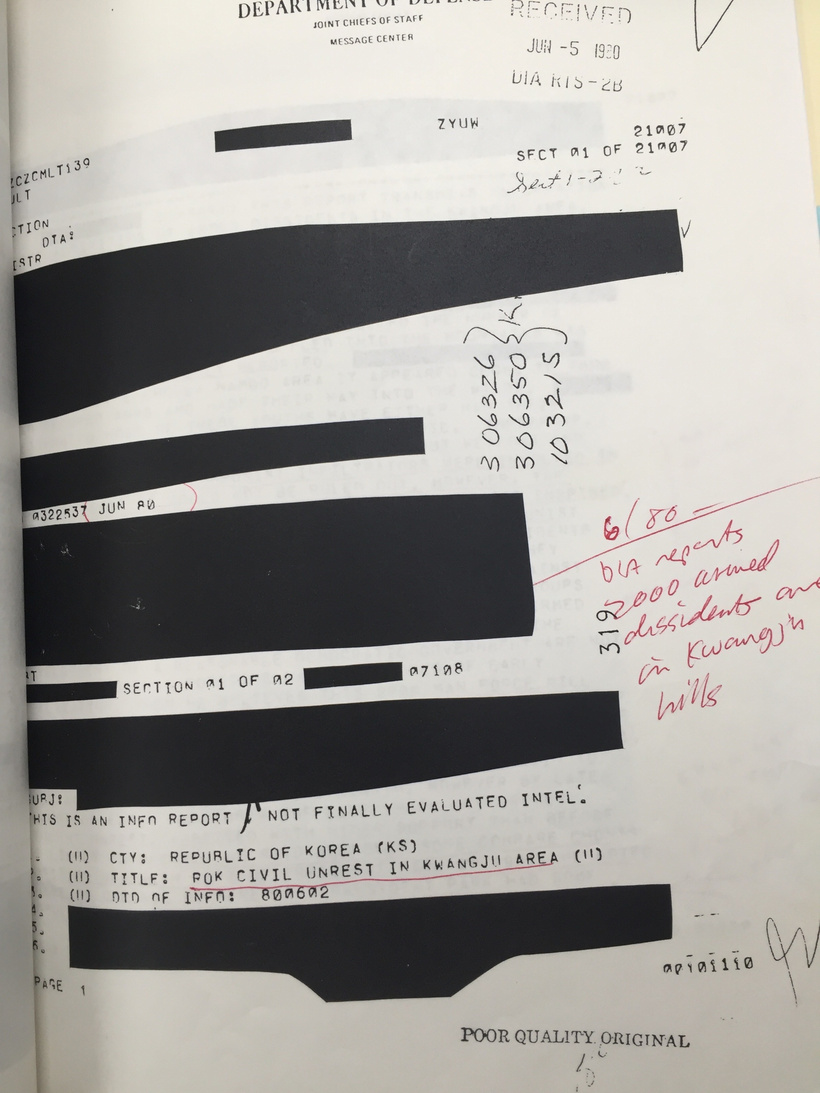
This document was the basis for my initial Freedom of Information Act (FOIA) request to the US government for documents on Gwangju. It was prepared by the Bush administration in 1989 in response to a request for information about US policy from the South Korean National Assembly, which was investigating the events in Gwangju at the time. Researchers looking through it will see my handwritten “FOI” markings; these indicate records or documents I requested in my FOIA request for my story that appeared in The Journal of Commerce in February 1996. For that reason, this document holds historical significance.

Screen Shot 2020-06-01 at 5.54.13 PM

Source: United States Government (prepared by State Department)

Note: After I published my Journal of Commerce and Sisa Journal articles about the US role in Gwangju in 1996, I learned that the primary author of the “White Paper” was John Merrill, who was Chief of the Northeast Asia Division of the Bureau of Intelligence and Research at the U.S. Department of State (the intelligence unit within the agency). He later told that, while writing this report, he relied exclusively on State Department and National Security Council documents, and did not have access to the many Defense Intelligence Agency documents I later obtained on Kwangju. This was shocking to me because the paper – an official government document – contained several false and misleading statements about the Special Warfare Command and other topics known to the Defense Intelligence Agency (DIA). Therefore, it is difficult to call this a complete report. 

The most significant statements in the White Paper concern 1) the Combined Forces Command and the US explanations of what constitutes operational control, or OPCON; and 2) the possibility of North Korean attack on or involvement in South Korea at the time of Kwangju, both of which are strongly denied by the US government. In this analysis, key pages and points are listed:

p. 3 – “Neither troops of the SWC nor elements of the 20th Division, employed by the MLC in Kwangju, were under CFC OPCON, either at the time they were deployed to the city or while operating there.” The US also claims it “had neither prior knowledge” of or “responsibility” for the SWC deployments to Kwangju.

p. 3 – “No information indicating a North Korean intention to attack was received by the United States” during the period covered by the White Paper.

p. 5 – Detailed explanation of the responsibilities of the CFC. “Its sole mission is defense against external attack.”

p. 5 – After the Park assassination, Korean military authorities “notified the CINC/CFC that the Korean Army would assume OPCON of a number of units, including the 20th Infantry Division, for deployment to Seoul as a precaution against possible disorders in the wake of the assassination.”

p. 11 – On May 16, “Korean military authorities notified CFC officials of their intent to remove the 20th Division’s artillery and its 60th regiment from CFC OPCON.”

p. 14 – Korean military units used for martial law in 2 categories: some never under CFC OPCON and those removed from CFC OPCON. “The brigades mobilized from the SWC and the 31st Division, based in Kwangju under the 2nd ROK Army, had not been under CFC OPCON.” Elements of the 20th Division had been removed from CFC OPCON.

*p. 15 – “All available channels were used to urge moderation and patience. The key channel was military, through General Wickham, whose primary contacts were General Lew Byong Hion and the ROK Joint Chiefs of Staff.” This is significant and borne out in the FOIA documents: Wickham’s primary source was General Lew.

p. 16 – “US officials in Seoul agreed that use of the specially trained 20th Division…would be preferable to continued deployment of the SWC against the citizens of Kwangju. General Wickham and Ambassador Gleysteen therefore responded to a query from the ROK authorities…that they reluctantly accepted that it would be preferable to replace SWC units with elements of the 20th Division…Although the MLC was not required to notify the CFC of the movement to Kwangju of elements of the 20th Division as it was no longer under CFC OPCON, it did so on May 20.” US officials assumed this was because of Gen. Wickham’s forceful protests over the 12/12 Incident.

p. 16 – On May 21, the Korean government asked the US government “to help deter North Korea from taking military advantage of unrest in the South. In response, the US on May 21 dispatched two E-3A Early Warning Aircraft to the Far East to watch for any signs of North Korean activity.” (They were dispatched to Okinawa).

p. 18 – On May 24, Gen. Lew told Gen. Wickham that the MLC “had finalized plans to reenter and retake Kwangju. Gen. Wickham acknowledged he could not dictate to the MLC, but he pointed out to General Lew that using military force to solve political problems usually made the situation worse…Lew promised restraint. Wickham reported to Washington that the likelihood of MLC forces having to reenter Kwangju was low because both he and Gleysteen believed that the Citizens’ Committee was having some success at calming the situation.”

p. 18 – “Korean military authorities also began to tell the US on May 25 that hard-core radical students had taken over the city, that their demands were excessive, and that they did not seem interested in good faith negotiations.”

p. 19 – After MLC forces entered Kwangju in the early morning hours of May 27, the MLC informed the CFC Commander (Wickham) “that the operation had been well-conducted and that, except for 30 persons killed after refusing the surrender their arms, casualties had been ‘light.’”

p. 19 – “The bulk of the forces used were from the 20th Division, not the SWC, which had provoked the incident.” However, SWC troops wearing regular army uniforms to disguise their identity had conducted the final assault on the Provincial Capital building, and other places in Kwangju, and only after the end of the fighting, had turned over their responsibilities to 20th Division forces.”

APPENDIX, p. 6 – Throughout this period, the US “remained alert to the possibility that heavily armed, unpredictable North Korea could perceive an opportunity to exploit the situation and order its massive military forces to attack…However, no indications of an imminent North Korean attack were ever received.”

APPENDIX, p. 18 – On OPCON: both South Korea and the US “retain their sovereign right to assert operational control (OPCON) over their forces at any time, and may thus assign such forces to or remove them from CINC/CFC OPCON without the consent of the other party. Only the commander with OPCON can…order forces to undertake any movements or military action. Notification to CINC/CFC of removal of forces from the operational control of the CINC/CFC is required as a practical matter in order that CINC/CFC may be aware of the extent of forces under his operational control at any time…”

Read the Bush administration’s white paper on Kwangju in its entirety.

Posted in Kwangju Declassified | Comments Off on Gwangju Archives | US Government “White Paper,” 1989

Gwangju Archives | May 22, 1980 White House Meeting

This is an online database of the 4,000 declassified US government documents on the US role in the Gwangju Uprising of 1980. The original copies of the documents known in Korea as the “Cherokee File,” are permanently stored and available for research at Gwangju’s 5.18 Archives in South Korea.

BOX 2, FILE 4: May 22, 1980 White House Meeting

FBD01C31-3122-461E-9B81-23EA00BB8B1C_4_5005_c

This critical document from the US National Security Council is the full notes to the May 22, 1980, meeting of the most senior officials of the Carter administration, where the decision was made to deploy military force to end the Gwangju Uprising.

The participants included the Deputy Secretary of State, Warren Christopher; Richard Holbrooke, assistant Secretary of State for East Asia and the Pacific; Zbigniew Brzezinski, Carter’s National Security Adviser; CIA director Admiral Stansfield Turner; Donald Gregg, the NSC’s top intelligence official for Asia and a former CIA Station Chief in Seoul; and U.S. Defense Secretary Harold Brown.

Carter’s foreign policy team quickly came to a consensus. “The first priority is the restoration of order in Kwangju by the Korean authorities with the minimum use of force necessary without laying the seeds for wide disorders later,” the minutes state. “Once order is restored, it was agreed we must press the Korean government, and the military in particular, to allow a greater degree of political freedom to evolve.”

The US position was summed up by Brzezinski: “in the short term support, in the longer term pressure for political evolution.” As for the situation in Kwangju, the group decided that “we have counseled moderation, but have not ruled out the use of force, should the Koreans need to employ it to restore order.” If there was “little loss of life” in the recapture of the city, “we can move quietly to apply pressure for more political evolution,” the officials decided.

Once the situation was cleared up, the cabinet agreed, normal economic ties could move forward – including an important $600 million Export-Import Bank loan to South Korea to buy American nuclear power equipment and engineering services. Within hours of the meeting, the US commander in Korea gave formal approval to the Korean military to remove a division of Korean troops under the US-Korean Joint Command and deploy them to Kwangju.

View full summary of conclusions.

Posted in Kwangju Declassified | Comments Off on Gwangju Archives | May 22, 1980 White House Meeting

2 Days in May That Shattered Korean Democracy

My latest on Gwangju, just posted at The Nation. 

This story is the result of my 5-year collaboration with Injeong Kim, the longtime 5.18 reporter for MBC-Gwangju. We interviewed key US officials involved in US decision-making in 1980, including the US commander in Korea, Gen John A. Wickham, and a top aide to Secretary of Defense Harold Brown. The story of US involvement is even worse than we originally thought.

invasion may 27

President Moon, who came of age as a political activist during South Korea’s authoritarian era, promised to give momentum to an independent truth commission that is investigating the Korean military’s use of force, including the question of who ordered the firing on civilians and sent a helicopter to strafe a building near Gwangju’s center. The commission, he said in an interview with the Gwangju affiliate of broadcast company MBC, would also seek to identify individuals who sought to “conceal and distort the truth” of the Gwangju Uprising.

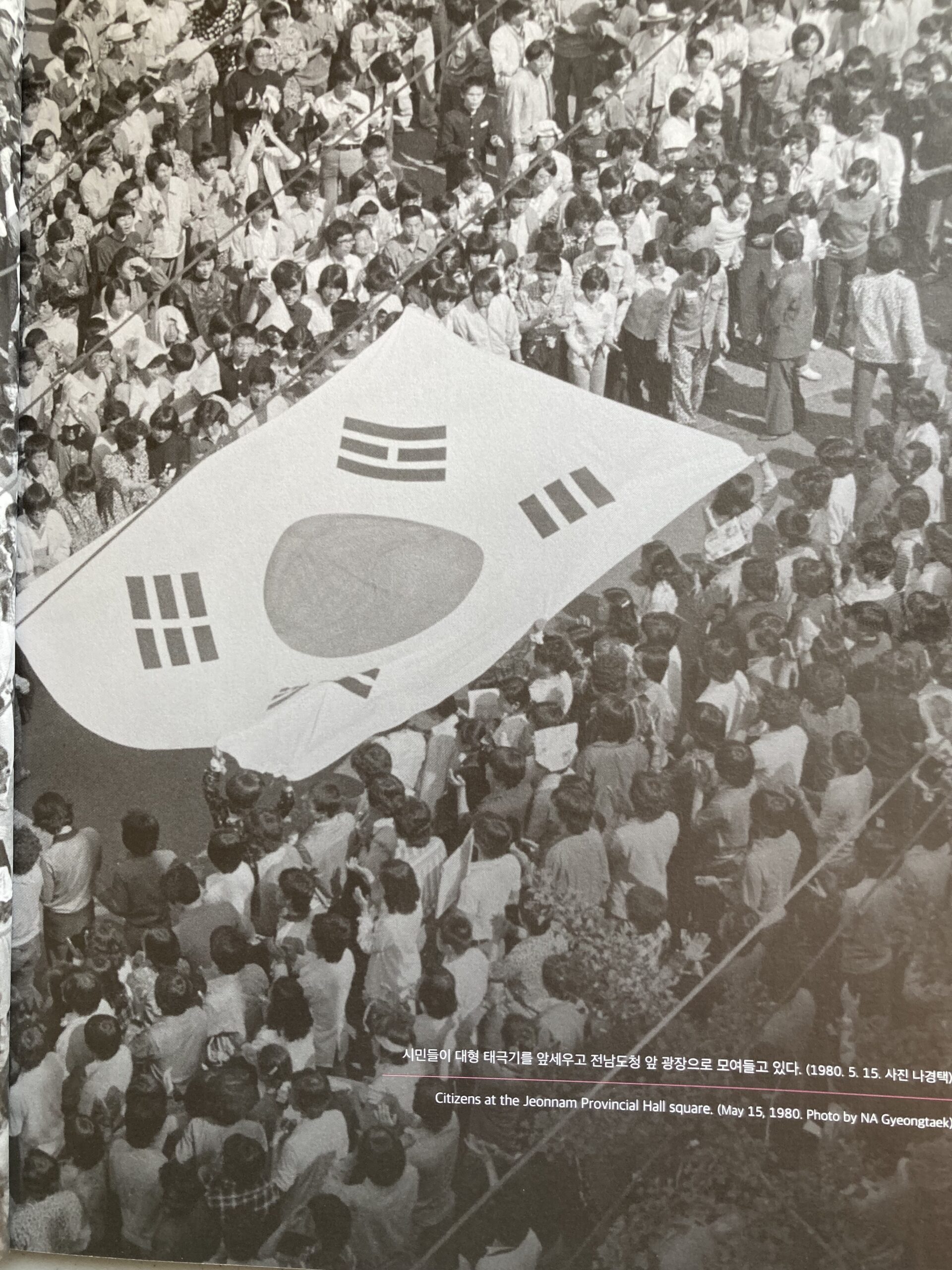
That’s a tall order, because that trail leads straight to the United States and its president, Jimmy Carter, who ran for office in 1976 vowing to make human rights the centerpiece of American foreign policy. Sadly, he failed to do that in Gwangju, sparking the worst crisis in US-Korean relations since 1945. What happened there stoked years of anti-American sentiment, and Gwangju has remained a point of contention ever since.

As some Koreans are painfully aware, the Carter administration played an essential role in Gwangju by helping the coup leader, Lt. Gen. Chun Doo-hwan, crush the uprising. At a high-level White House meeting on May 22 that we first reported in 1996, Carter’s national security team approved the use of force to retake the city and agreed to provide short-term support to Chun if he agreed to long-term political change (that, of course, didn’t happen until he was forced out by massive protests in 1987).

The stakes were high, and were exacerbated for US policymakers by the simultaneous crisis over the Islamic revolution in Iran, which eventually brought Carter’s presidency down. As the once-secret minutes to the White House meeting show, plans were also discussed for direct US military intervention in Korea if the situation in Gwangju spiraled out of control.

Posted in Kwangju Declassified | Comments Off on 2 Days in May That Shattered Korean Democracy